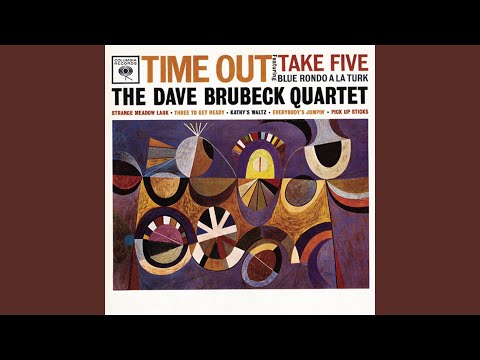
Dave Brubeck
Take Five
Read
Narration sentence highlighting is idle.
The piece begins by teaching the body what it will have to remember. Brushes set the uneven five-beat tread almost alone, quiet but already insistent; then the upright bass joins with the vamp that will become the floor of everything. When the piano enters near 0:12, it does not decorate a settled background so much as stamp the shape into place: clipped, memorable, a little off-center, with the fifth beat always making the loop feel both complete and freshly tilted. That two-chord ground is the form’s first fact.
The alto saxophone’s arrival around 0:21 changes the status of that vamp. What had been an exposed mechanism becomes a frame for line. Paul Desmond’s tone is so smooth that the odd meter stops sounding like a trick; the melody rides it with a dry elegance, cresting and dropping in phrases that keep returning to the same recognizable contour. The important memory here is not only the tune, but the way the rhythm underneath refuses to square itself. Each melodic release lands on a floor that is stable and asymmetrical at once.
As the saxophone continues, the form opens by degrees rather than by rupture. Higher phrases near the first minute brighten the surface, then the line drops into bluesier bends and mid-register turns. The rhythm section keeps the recurring pattern intact, so the ear can hear the saxophone’s freedom against something nearly architectural. Piano chords begin to answer more clearly underneath later in the chorus, accenting without taking over. The piece is already making its argument: repetition is not stasis when the soloist keeps changing the angle from which the same ground is approached.
When the foreground begins to shift around 1:48, the handoff to the drums is less a break than a transfer of agency. Joe Morello brings forward what has been implied all along: the rhythmic idea itself as principal material. The bass keeps enough of the pulse present for orientation, while the drum set starts speaking in accents, rolls, and displaced emphases. The same meter that earlier made the melody glide now becomes something to test from inside.
This long drum feature is the piece’s transformed recurrence. The vamp is no longer chiefly a harmonic object or a backdrop for melody; it is a measuring device, a grid made audible by friction. Rolls gather, accents lean across the bar, and the brushes-and-drum language keeps teasing the listener’s count without losing it. Because the opening taught the pattern so plainly, these later rhythmic pressures feel intelligible rather than chaotic. The form asks the body to remember five while the drummer keeps showing how many ways five can be unsettled.
The length of this middle matters. It is not a late, brief episode added for contrast, but the place where the whole design is re-heard. What began as accompaniment becomes argument: the original five-beat cell keeps turning while the surface changes shape around it. Nothing needs to announce development; the development is the widening gap between the steadiness of the ground and the accumulating pressure of its returns.
The return of the ensemble near 4:22 feels smaller than a grand recapitulation and cooler than a victory lap, which is exactly right for the piece. The familiar material comes back with the memory of the drum feature still inside it; the vamp sounds less like accompaniment now, more like the source from which the whole performance has been drawn. Saxophone and piano regain the foreground, but the ear has been retrained to hear the rhythmic engine as an equal protagonist.
In the final measures, the pattern lifts and releases rather than collapsing. The last phrase gathers a final bit of upward motion, the pressure eases, and around 5:18 the mechanism stops holding the room. What remains is not simply the famous melody, but the memory of a form built from a small asymmetry: five beats, two chords, a line elegant enough to float above them, and a drummer patient enough to reveal how deep that little loop goes.
Last updated Aug 15, 2026 · Written with GPT-5.5 · Galdr 0.7.0.dev0 · Inner Ear Gemini 3.5 Flash Lite
Now playing
Take Five
Dave Brubeck

galdr analysis
Click play to load galdr data.