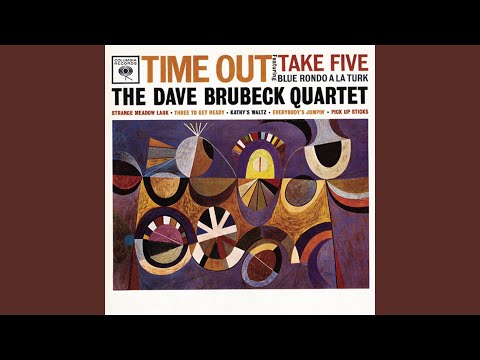
Dave Brubeck
Take Five
Read
Narration sentence highlighting is idle.
Brushes first — a soft circular motion on a drum head, already setting the five-beat cycle before anything else arrives. The feel is neither heavy nor light; it is a pulse offered with the hand, not driven with the shoulder. Within a few seconds the upright bass walks in underneath, and the vamp begins its long occupation of the track's center. The bass sits warm and low-mid, grounding the harmonic floor while the brushes keep the surface moving above it. Two instruments, and already the listener's body is caught in something it cannot quite settle into — the five-beat bar keeps pulling the accent around, so the groove arrives without ever fully resting. The pocket is real, but it is a pocket that walks.
The piano enters around twelve seconds in, stating the melody in that clipped, almost percussive touch Brubeck uses — each note placed with a slight edge, not sustained. The line moves in the familiar blues-scale shape, but the phrasing keeps landing between the beats, leaning across the grid rather than sitting on it. This is where the track's particular tension becomes audible: the rhythm section holds a steady cycle, and the melodic line keeps walking around it, arriving slightly early, slightly late, never quite where a four-beat ear expects. The phrase crests and resolves, and then the saxophone enters around twenty-one seconds — Paul Desmond's alto, dry and centered, sitting forward in the mix with almost no air around it.
Desmond's tone is the track's most distinctive surface: clean, unvarnished, carrying breath pressure without breath sound. He climbs into the upper register around fifty-three seconds, and the line brightens without the timbre changing — the same dry tone, just higher, pressing more air through the same narrow opening. The band underneath does not thicken. Bass vamp, brushes, the occasional piano chord — the density stays medium, the surface stays open, and the saxophone carries nearly all the forward motion by itself. When the phrases accelerate into faster syncopated runs around ninety-four seconds, the rhythm section does not chase; Morello's brushes keep their orbit while Desmond's line spins faster above.
The saxophone solo sustains this relationship — the body captured by the vamp, the ear following Desmond as he pushes, crests, drops back, pushes again. Around one minute forty-eight, the melodic voice withdraws and the drums move into the foreground. The track's genius is that the pressure builds while the groove never changes weight.
Morello's feature begins with the bass still pulsing underneath — the vamp continues, but the percussion takes the foreground. The brushes give way to sticks, and the surface hardens. By around three minutes three seconds the drum feature is already established, and around three minutes twenty a fast snare roll builds volume. The track's sustained pressure tilts forward rather than holding. The accent phase drift that has been present all along becomes the whole event: Morello is walking around the barline, filling the five-beat frame with strikes that lean across it. The body is still captured, still pulled by the same cycle, but the surface is busier, more particulate, the smooth brush texture replaced by sharper individual hits.
The vamp returns, the saxophone re-enters, and the track settles back into its held state — the same two-chord floor, the same dry alto tone, the same walking pocket. Nothing collapses, nothing ruptures. The pressure has been sustaining for nearly the entire duration, and the track's refusal to break is its argument. Then at five sixteen the pressure releases, the pattern breaks, and within a few seconds the sound is gone — clean acoustic silence, no fade, no residue. The five-beat cycle simply stops, and the body, which has been held in that slightly uncomfortable groove for over five minutes, is released into ordinary time.
Last updated Aug 15, 2026 · Written with GLM 5.2 · Galdr 0.7.0.dev0 · Inner Ear Gemini 3.5 Flash Lite
Now playing
Take Five
Dave Brubeck

galdr analysis
Click play to load galdr data.