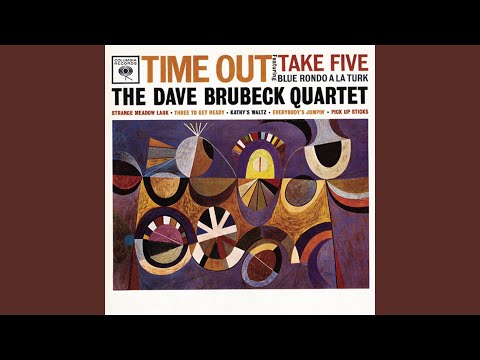
Dave Brubeck
Take Five
Read
Narration sentence highlighting is idle.
0:00-0:21 Establishing the vamp
Drum brushes, then upright bass, then piano enter in sequence to build the 5/4 groove. The rhythm section assembles the two-chord vamp and the metric frame before any lead voice arrives.
0:21-~1:48 Saxophone states the theme, then improvises
The alto saxophone enters around 0:21 with the blues-scale melody. After the theme statement, the saxophone stays to improvise over the same vamp, climbing through register shifts and phrase crests. Piano chords join underneath around 1:23, adding harmonic support without changing the underlying contract. The saxophone winds down its solo near 1:48.
~1:48-~4:22 Drum solo
The saxophone exits and the drums step forward. The rhythm section thins to drums and bass pulse while the drummer builds through rolls and dynamic lifts, keeping the 5/4 meter intact as the foreground instrument.
~4:22-~5:12 Theme return
Weight lifts and the saxophone re-enters with the original melody, restoring the A section. The vamp and rhythm-section support continue underneath as before. The theme restatement proves the frame still holds after the solo departure.
5:12-5:24 Release and close
A final phrase lift gives way to pressure release and pattern break around 5:18. Motor capture recedes and the track empties into silence by 5:24.
The whole form is ABA: a presented theme, an extended solo departure over the same vamp, and a clean return to the theme.
Last updated Aug 15, 2026 · Written with GLM 5.2 · Galdr 0.7.0.dev0 · Inner Ear Gemini 3.5 Flash Lite
Now playing
Take Five
Dave Brubeck

galdr analysis
Click play to load galdr data.