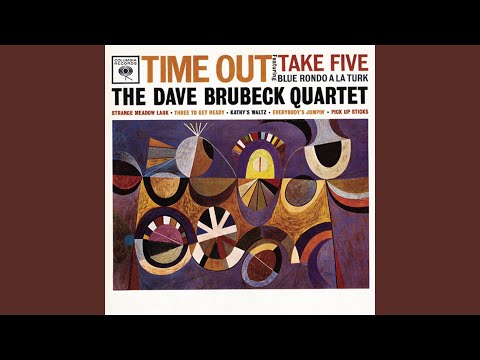
Dave Brubeck
Take Five
Read
Narration sentence highlighting is idle.
Brushes first — quiet, circular, already setting the five-beat measure before anything else arrives. The drums don't announce; they settle into place like someone already mid-thought. Then the upright bass walks in with the two-chord vamp, and the floor is there: low, steady, unhurried. The piano enters around 0:12 with the melody everyone knows, but hearing it build from these spare layers is different from meeting it fully formed. Brubeck's left hand keeps the vamp while the right traces that blues-scale line in E♭ minor, and the odd meter — five beats grouped as 3+2 — doesn't feel odd yet. It feels like a room you've walked into.
Desmond's alto saxophone enters around 0:21, and the temperature shifts. His tone is the thing: dry, light, almost conversational, with very little air in it. Where a harder sax sound would push against the vamp, Desmond floats above it. The rhythm section keeps its pocket — Morello's brushes, Wright's bass — and the saxophone phrases ride that stability, climbing, cresting, dropping back. Around 1:00 the line pushes higher with more breath, holds a sustained tone, then falls into a bluesy descent. The pattern is already clear: the vamp holds still while the saxophone explores outward, and the tension lives in how far the melodic line stretches before it returns home.
The solo accumulates. Around 1:23 Brubeck's piano chords enter underneath, thickening the support without changing the groove, and Desmond responds with faster, more syncopated runs. The phrases get shorter, more pointed — staccato bursts around 1:41 — and then open up again into longer arcs. The alto climbs into its bright register near 1:40, hits a crest with sharp articulation, and settles back. What the recording does so well is keep the rhythm section exactly where it is while the saxophone moves through all this territory. The body stays captured by the pocket even as the surface above it shifts and turns. The 5/4 never becomes a stunt; it's just the ground the whole thing stands on.
Near 1:48 Desmond recedes, and Morello's drums step forward. The drum solo changes the role of the kit from support to voice. Morello keeps the pulse implied even as he builds volume and complexity, and the bass stays underneath as a thread. The body is still held in the rhythm, but the surface has thinned, and the focus narrows to what the drums can do inside the meter without losing it.
The return comes around 4:22 — the A section back, the vamp and the melody reasserting themselves after the drum solo's excursion. What's changed is subtle: the accumulated listening makes the return feel earned, a home base re-established after the ground was tested. The saxophone and piano move through the familiar material, and the pattern holds its shape through 4:38 and 5:12 with phrase lifts marking the last passes. Then, near 5:16, the pressure releases. A few seconds later the pattern breaks — the motor hold loosens, the brushes stop, and the sound thins to silence by 5:24. The ending isn't a grand gesture; it's the groove letting go of the body it held for over five minutes, and the quiet after it is the cleanest thing on the record.
Last updated Aug 15, 2026 · Written with GLM 5.2 · Galdr 0.7.0.dev0 · Inner Ear Gemini 3.5 Flash Lite
Now playing
Take Five
Dave Brubeck

galdr analysis
Click play to load galdr data.