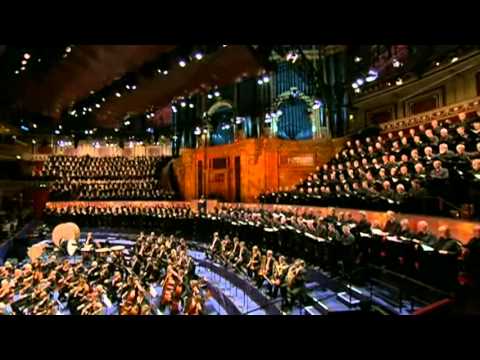
Loading YouTube player…
Giuseppe Verdi
Dies Irae
Read
Narration sentence highlighting is idle.
The first five seconds are not an empty count-off so much as a held breath in a large room. Then the entrance lands as a hard orchestral shock: low drum force, brass glare, and strings already moving fast enough that the silence feels split open rather than simply ended. Almost immediately the choir adds mass to the front of the sound, not intimate or speechlike but blocky, percussive, hurled in compact shapes over the rushing orchestra.
Once the motion catches, the recording keeps a fierce grid under it. The pulse is fast and reliable, but the body does not get a comfortable groove seat; it is grabbed by repeated accents, hammered low strikes, and choral attacks that keep arriving square and severe. Around 0:35 the surface sharpens into staccato choral articulation over driving strings, with brass flashes cutting across the texture. The force is not just loudness. It is the way attacks stack: voices, drums, brass, and string motion all pressing into the same forward lane.
The first long plateau keeps renewing itself by small drops and lifts rather than by leaving the pressure behind. Around 0:49 the choral layers begin to feel more braided, different voice parts entering and shifting against active orchestral motion, but the overall shape remains locked and severe. Near the minute mark the mass swells again into heavy accents and sustained choral blasts, the percussion giving each blow a physical bottom while the brass keeps the upper edge bright and almost metallic.
The contraction after the big crest is one of the most striking changes because the pulse memory remains even as the room thins. By about 1:35 the orchestra has softened, and the choir no longer fills the space as a wall; the sound narrows into tense murmuring, low strings, distant drum taps, and a kind of tremulous held air. The body is still waiting for the earlier impact to return, but the recording withholds it, letting the hall and low resonance become audible around the fragments.
When the voices fall away near 2:15, distance takes over. A soft brass call appears across the room, answered by another, and the piece suddenly has depth instead of frontal assault. The antiphonal fanfare grows by accumulation: one line becomes several, trumpets layering into rhythmic patterns, harmony widening, volume swelling without losing the sense that the sound is traveling through a large acoustic space. By roughly 3:05 the brass has become a broad ceremonial machine, bright and ringing, with the room’s reverberation extending every edge.
The choral return around 3:35 restores the earlier wall, now with the brass fanfare energy folded into it. Voices and orchestra occupy nearly the whole field again, and the percussion gives the re-entry its floor. Then the cut near 4:05 is abrupt enough to change the air: the mass stops, and the hall decay becomes the main sound. After those gaps, a single low male voice enters in a much barer space, supported sparsely below, its grain and register replacing the earlier crowd-force with one dark line.
The ending keeps reducing the body until only resonance remains. The solo voice descends and softens, the accompaniment barely thickening around it, and the final seconds let the hall swallow what is left. After so much seized pulse and choral pressure, the last audible fact is not impact but decay: a low, fading trace, then room silence.
Last updated Aug 28, 2026 · Written with GPT-5.5 · Galdr 0.7.0 · Inner Ear gemini-3.7-flash

galdr analysis
Click play to load galdr data.
Now playing
Dies Irae
Giuseppe Verdi
Click play to load galdr data.
Music signal
Surface evidence
Harmony + melody
galdr concepts
Derived motion