Giuseppe Verdi
Dies Irae
Read
Narration sentence highlighting is idle.
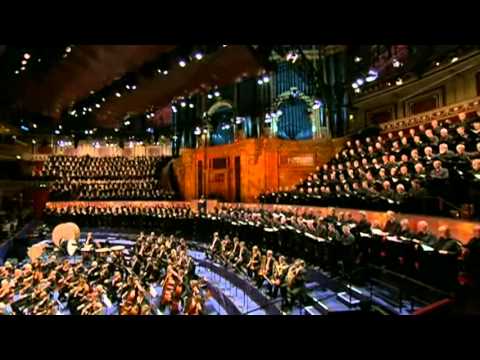
The first five seconds matter because they give the entrance a wall to break. Out of the quiet hall, the orchestra does not so much begin as strike: bass drum weight, brass glare, racing strings, a vertical blow that immediately establishes the material the ear has to remember. The chorus arrives at 0:08 with Dies irae as a massed declaration, not an individual line. Its force comes from the unanimity of attack and from the way the orchestra keeps throwing hard accents under it, so the phrase feels less like melody than a judgment repeatedly made audible.
That opening idea is built to return. Short choral blocks, percussion blows, and rushing string motion keep compressing the same terror into recognizably shaped units: down, lift, strike again. Around the first half-minute, the choral writing starts moving in sharper rhythmic articulation, the voices cutting the Latin into hard syllabic edges while the orchestra churns beneath them. The words about trembling and judgment do not need much explanation because Verdi has already made the form tremble: every phrase seems to fall back only to be driven upward into another accusation.
When Dies irae comes back near 0:53, it is not simply a repeat of the first entrance. The listener now remembers the opening blow, so the renewed cry carries the pressure of recognition. Brass and percussion make the return brighter and heavier, and the chorus sounds as if it has been gathered into a larger public force. The important thing is the accumulation: what first sounded like a shock becomes a mechanism, a repeated sentence the piece keeps passing through different intensities.
The great change is not a new theme at first, but a withdrawal. After the fortissimo plateau, the texture thins; by roughly 1:35 the choir has softened into tense, low, almost furtive fragments. The orchestra no longer fills the room with impact. Low strings murmur, distant drum taps punctuate the hush, and the repeated cuncta stricte becomes frightening in another way: not the crowd crying out, but the verdict being counted under the breath. The earlier material is still in memory, and that memory makes the quiet feel exposed rather than calm.
Then the room itself becomes part of the form. A distant trumpet call emerges around 2:25, alone in the acoustic space, and the ear has to reorient from choral mass to spatial signal. Answering brass calls arrive from elsewhere, each one lengthened by hall resonance, until the fanfare grows into antiphonal architecture. This is the most decisive contrast in the excerpt: after the condensed, hammering choral terror, the sound opens outward, as if distance has become an instrument. The text’s trumpet image matters because the music does not merely mention it; it stages the call across space.
As more brass joins, the fanfare thickens from isolated summons into public proclamation. By the time the chorus and orchestra surge back around 3:35, the opening violence has been reframed. The re-entry is still hard and immense, but now it follows the trumpet’s spreading call, so the massed voices feel summoned rather than merely unleashed. What the listener remembers from the first minute—the blows, the choral unanimity, the racing orchestral pressure—returns with a new cause behind it.
The cut after 4:08 is startling because the previous sections have taught the ear to expect force answering force. Instead, resonance empties out, with short gaps and unsettled continuation before a single low voice enters around 4:28. The bass soloist changes the scale of the drama completely. After the chorus as crowd and the brass as cosmic signal, one human register is left to carry Mors stupebit et natura: death and nature stunned, sung not as spectacle but as grave declamation over sparse support.
That final thinning is the destination of these five minutes. The excerpt begins with collective impact, expands into spatial summons, and ends by narrowing to a solitary voice fading toward silence. The opening crash is still remembered at the close, but it no longer owns the whole piece; Verdi has made terror pass through mass, distance, and finally the exposed weight of one low line.
Last updated Aug 28, 2026 · Written with GPT-5.5 · Galdr 0.7.0 · Inner Ear gemini-3.7-flash
Now playing
Dies Irae
Giuseppe Verdi

galdr analysis
Click play to load galdr data.