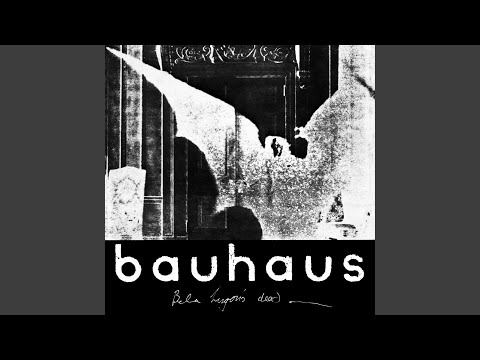
Bauhaus
Bela Lugosi's Dead
Read
Next narration 0:01
Narration sentence highlighting is idle.
Half a second of silence, and then a dry, clipped tick, close and perfectly regular.
Bass now, low, circling the same few notes, with bright little guitar scratches flashing at the edges.
The figure lifts once, drops back, then lifts again. Small movements inside the same stride.
By now the pattern is just there. Bass circling, percussion ticking, small guitar glints cutting across the top before it settles back.
Galdr reads the pulse at about 103 and it never wavers. The rhythm's got the body by now, though it's a strange kind of comfort.
A small break around 1:36. The groove lets go for a moment, then picks the same walk right back up.
Dub-like discipline in the spacing: a sound, a gap, the return. Nothing crowds anything else, and nothing hurries.
Two and a half minutes in, a voice at last, high and pale, stretched long across the tick: 'White on white.'
'Bela Lugosi's dead' delivered half as public notice, half as spell, and the groove under it doesn't mourn; it just keeps walking.
Every image gets the same cold floor. No swell for the velvet, no hush for the tomb; the tick just keeps its circuit.
The title came round again, and now the answer is the hinge word: 'undead, undead, undead.' Less news each time, more a sound the mouth can run on.
Now the images move in procession, 'the virginal brides file past his tomb,' handed over one at a time, at the same even pace, over an unchanged groove.
Then the whole apparatus steps aside for two words: 'The count.' Set down like an object under a light.
The 'undead' calls take over from the title now, two triplets back to back, each pass a little emptier, more ritual than report.
One 'Undead' left hanging at 4:44, and then it's just the band: tick, bass, scratches, carrying the whole thing alone.
Around five minutes, the figure starts lifting again, small steps upward, the first real movement in quite a while.
By 5:45 the low end has gathered another layer of insistence. No rush, just a harder lean, and the guitar stays scratches and echoing angles, never a lead line.
The attacks keep landing just off the spot where the body would relax. You can move to this for minutes and never quite settle. No voice now, and nothing missing.
The voice is back, and the address has changed. 'Oh Bela' is less a report than a call into the tomb.
Call and answer, around and around, 'Bela's undead' with more swing than certainty, while the band underneath hasn't changed a single thing.
After 7:37 the chant falls back and the pattern stands out on its own again. Straighter, easier to move with, the comfort still provisional.
A single 'Undead' at 8:11. One word, and then the pattern alone for a long stretch.
A small catch in the pattern around 8:45, attention snags on it, and then the stride resumes.
The figure lifts again at 8:54, but this doesn't sound like a build. It sounds like the track lifting its head.
Same lift near 9:10, more terminal each time. Bass and percussion still going, with less and less around them.
The pattern turns over once more at 9:22, nearly bare now, bass and percussion and not much else.
And it stops. Tick, bass, everything at once. Nine and a half minutes of that walk, and then plain silence.
Last updated Aug 21, 2026 · Written with GLM 5.2 · Galdr 0.7.0.dev0 · Inner Ear Gemini 3.5 Flash Lite
Now playing
Bela Lugosi's Dead
Bauhaus

galdr analysis
Click play to load galdr data.