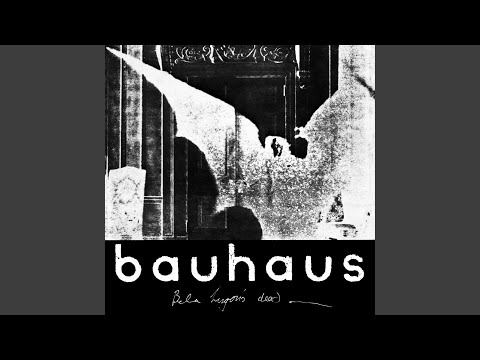
Bauhaus
Bela Lugosi's Dead
Read
Narration sentence highlighting is idle.
A drum figure walks in alone, thin and trebly, already wrapped in a cavernous echo — a tick, a snap, and the wide space they keep coming back from. What gets me every time is how fast the pulse takes the body: within seconds the beat has you, even though almost nothing is playing. A faint scraping sits at the edge of the mix, and that's nearly the whole picture for a long while. Here, space is an instrument; every hit returns seconds later, softened, from somewhere far away.
The build is staggered with real patience. The bass arrives early with a figure of maybe four notes, a guitar chord bends in over the ticking, and a soft keyboard shimmer drifts through. From there the shape is fixed: drums ticking, bass circling its few notes, guitar smearing color across the top. The strikes lean slightly around the beat rather than landing square on it, dub patience written into the attack, so the pocket grips without ever getting comfortable. The body is captured; settling in is not part of the deal.
At 2:42 the voice finally appears — Peter Murphy's baritone, speak-sung and deadpan, a master of ceremonies more than a singer. White on white translucent black capes, he intones, the costume returned to its rack, and then the title line lands flat as a news bulletin while the bass circles on underneath. That's the eerie math of the recording: the words stage a funeral and the groove never once mourns. By the undead, undead, undead chant the language has stopped being lyric at all — chanted square on the grid, the phrase has become another percussion part.
The virginal brides file past the tomb, the count is named, the title line keeps coming around, and around four and three-quarter minutes the voice simply stops. What follows is nearly two minutes of the vamp turning over on itself, and the drama is the refusal: no lift, no extra notes, only small flickers of guitar. Pressure never builds here; it is held. The track banks your expectation and pays no interest, and that discipline turns out to be the excitement.
The return at 6:43 is the song's quiet surprise. Oh Bela — suddenly soft, almost tender, a call instead of a pronouncement — and the news that Bela's undead comes repeated like consolation rather than threat. The vamp is identical; only the voice's posture has moved. Somewhere inside all that deadpan, the send-up of a dead horror star has become a send-off for him.
Afterward the guitar finally gets the room to itself: a sharp squeal, long feedback, delay-stacked swirls riding the unchanged tick — the one stretch where the surface is allowed to rage. A single last undead surfaces from the distance a little past eight minutes, more trace than performance. Then, around 8:45, the floor starts pulling out: the bass recedes, the guitar thins to shimmer, and the drums come back to that lone ticking figure in the big room. Past the nine-minute mark the pressure finally lets go and the echo is left to finish by itself. What ends the record is what began it — one small pattern dissolving in a very large space. The last thing you hear is the room.
Last updated Aug 21, 2026 · Written with GLM 5.2 · Galdr 0.7.0.dev0 · Inner Ear Gemini 3.5 Flash Lite
Now playing
Bela Lugosi's Dead
Bauhaus

galdr analysis
Click play to load galdr data.