Mozart
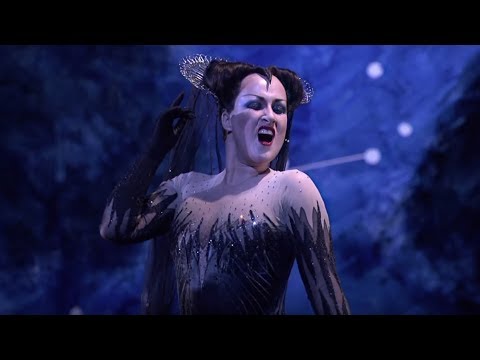
The Magic Flute – Queen of the Night aria (Mozart; Diana Damrau, The Royal Opera)
Read
Narration sentence highlighting is idle.
A short pocket of hall silence tightens the entrance rather than emptying it. The first sound is already theatrical in scale: soprano and orchestra arrive together, the voice hard-edged and forward, the chords behind her striking in compact blocks. The pulse settles quickly under that declamation, not as a loose operatic wash but as a gripped, repeatable motion. Even when the voice stretches upward, the accompaniment keeps sending clean impacts back into the room, so the body gets caught between vocal height and orchestral punctuation.
The early force does not simply keep growing. Around 0:14 the texture thins, and that thinning matters: the soprano drops into a less blazing band of the instrument, the strings become a quieter pulsing surface, and the whole recording suddenly has more air around its edges. The pressure has not vanished; it is suspended. The strings keep time with a light insistence while the voice gathers itself again, climbing through a line that feels pulled forward by the orchestra’s rising figures rather than carried on a broad cushion.
By about 0:36, the sound changes its mechanics. The broad dramatic attack gives way to coloratura: detached high notes, quick leaps, and bright little articulations that sit over a much lighter orchestral floor. The body is still captured, but now by precision instead of mass. Those high staccato figures do not feel weightless exactly; they flick against the grid, landing with enough regularity to make the pulse readable while the attacks keep leaning around it. The orchestra stays crisp and comparatively spare, leaving the soprano’s upper register exposed like a blade catching light.
The middle of the track keeps alternating between that needlework and larger orchestral pressure. Near 1:07 the voice opens into a sustained high crest while the ensemble thickens beneath it, and the room fills in a way the earlier coloratura had withheld. The cadential arrival shortly after has real local weight: the orchestra lands hard enough to take over the foreground, and for a stretch the soprano disappears. In that instrumental passage, the strings and lower colors push the motion forward with marching chords and agitation, less like accompaniment than like a machine resetting the stage.
When the soprano returns around 1:29, the recording snaps back to a confrontational close-up. Her attacks are firm, answered by tight orchestral chords, and the pulse underneath feels settled even as the accents keep rubbing against the barline. That friction is part of the pleasure: the beat is never lost, but the surface refuses to sit politely on top of it. The later runs, especially after 1:51, bring back the high, cascading agility over light strings, so the track again trades sheer weight for dangerous balance.
Past 2:07 the broad line and the ornamental flights begin to feel folded into the same physical argument. The orchestra can swell with rich harmonic body, then clear space for another run; the voice can cut high and fast, then broaden into a ringing held tone. A brief internal thinning near 2:34 works less like a rupture than a reset, a small withdrawal before the final push gathers. The closing orchestral chords strike with decisive tutti weight, and after the last resonance loosens, the applause rises into the hall sound, changing the space from staged pressure to a room answering back.
Last updated Aug 26, 2026 · Written with GPT-5.5 · Galdr 0.7.0.dev0 · Inner Ear gemini-3.7-flash
Now playing
The Magic Flute – Queen of the Night aria (Mozart; Diana Damrau, The Royal Opera)
Mozart

galdr analysis
Click play to load galdr data.