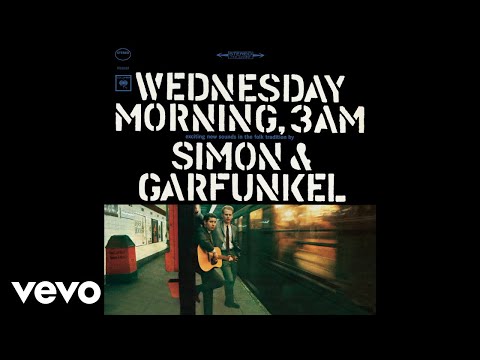
Simon & Garfunkel
The Sound of Silence
Read
Next narration 0:00
Narration sentence highlighting is idle.
Just a small guitar figure at first—steady, almost weightless, already filling the dark.
Voice right up close: "Hello, darkness, my old friend"—plain, like walking back into a familiar room.
There's a quiet pulse under him now, inward more than driving, as he comes to talk again.
The line stretches out on the vision planted in his brain, harmony turning under every step of the melody.
"Still remains"—then the first landing: within the sound of silence.
Second verse opens in restless dreams, walking alone down narrow cobblestone streets. Same restraint, a little wider scene.
Halo of a street lamp, collar turned to the cold—doubled voices holding a careful, even line.
Eyes stabbed by a neon flash—and "that split the night" cuts clean without the track needing to get loud.
It touches the sound of silence again, the strum still steady underneath.
Naked light now—ten thousand people, maybe more. The room feels colder with the crowd in it.
"People talking without speaking"—and the arrangement does the opposite: two voices fused so tight separation almost disappears.
Hearing without listening. The blend stays fragile and exact, syllable against syllable.
Songs that voices never shared—then no one dared disturb that silence. The pulse keeps walking.
"Fools," said I—he's turning outward now. Silence like a cancer grows.
The body of the song gets more insistent here—hear my words, take my arms—trying to teach and reach.
But the words fall like silent raindrops. That failure doesn't collapse the track; it just lets the fall land.
Echoed in the wells of silence—the steady motion suddenly feels severe against how little gets through.
People bowed and prayed to the neon god they made. The verse turns public without exploding the shape.
The sign flashes out its warning in the words it's forming—still that same controlled walk underneath.
Prophets' words written on the subway walls and tenement halls—an ordinary civic surface made to carry what no official voice will.
Whispered in the sounds of silence—last line, still close, still unforced.
Voice done. The pattern loosens, resonance drops away, and the room goes back to a short charged quiet—same stillness the first line opened.
Last updated Aug 24, 2026 · Written with Grok 4.5 · Galdr 0.7.0.dev0 · Inner Ear Gemini 3.5 Flash Lite
Now playing
The Sound of Silence
Simon & Garfunkel

galdr analysis
Click play to load galdr data.