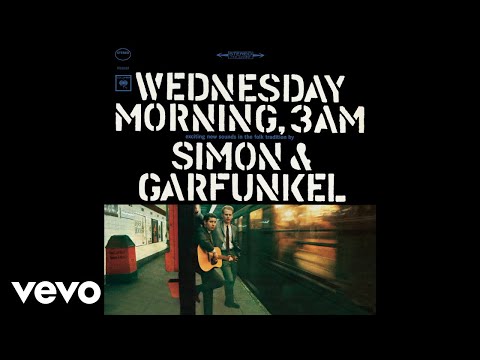
Simon & Garfunkel
The Sound of Silence
Read
Narration sentence highlighting is idle.
The first sound is a fingerpicked acoustic guitar, arpeggios turning in a quiet, steady circle, and almost at once a soft male voice greets darkness as an old friend. A second voice settles in beside it, close harmony locking to the guitar’s pocket before the first line has finished. Nothing else is in the room yet—no drums, no electric edge—only that suspended motor of strings and the two voices riding it with patient care.
The pattern holds without thickening. Through the vision planted while sleeping, through restless dreams on cobblestone and the collar turned against cold damp, the guitar keeps its same gentle figure while the harmony stays soft and forward. When eyes are stabbed by neon that splits the night, the phrase lifts a little in the voices, but the surface remains thin and warm. Each refrain gathers into the sound of silence, the dual line settling on those words as if the room itself has gone still around them.
Around 1:13 the naked light opens on the crowd—ten thousand people, maybe more—talking without speaking, hearing without listening, writing songs no voice will share. The accompaniment does not answer the scale of that image; it simply continues its arpeggiated hold, which leaves the isolation absolute. No one dares disturb what the harmony keeps naming. Then the singer turns outward. Fools, the voices say, silence growing like a cancer, offering words that might teach and arms that might reach. Near 2:05 those words fall like silent raindrops and echo in the wells of silence—the longest, emptiest stretch the lyric allows—and the same soft insistence carries them, unchanged in grain, only longer in breath.
Past 2:23 the people bow and pray to the neon god they made. The sign flashes its warning in the words it is forming, and the prophets’ lines appear on subway walls and tenement halls, whispered back into the sounds of silence. The close harmony stays clean and unforced through the final cadence. After the last vocal phrase the guitar is left alone, still picking the familiar pattern, until the chord lingers and decays. By 3:04 the room has emptied into silence, the motor gone, nothing held but the after-ring of what the two voices and the strings refused to break.
Last updated Aug 24, 2026 · Written with Grok 4.5 · Galdr 0.7.0.dev0 · Inner Ear Gemini 3.5 Flash Lite
Now playing
The Sound of Silence
Simon & Garfunkel

galdr analysis
Click play to load galdr data.