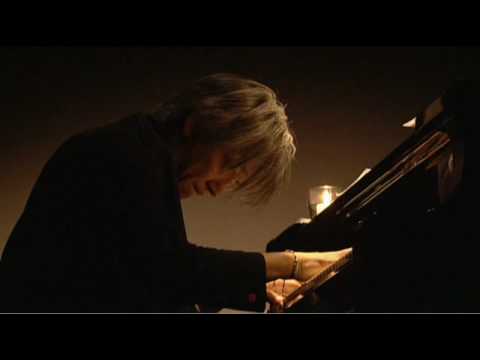
Ryuichi Sakamoto
Merry Christmas Mr. Lawrence
Read
Narration sentence highlighting is idle.
A little blank air comes first, just enough to make the first piano touch feel placed rather than begun by accident. The opening notes arrive alone, close and dry enough that the hammers matter, but not so close that the room disappears. The right hand carries the theme in clean, rounded tones while the left hand gives it a soft floor, less a beat than a recurring sway. The body can follow it, but it is not pushed into motion; the pulse is offered through repetition and spacing, held in suspension.
The early phrases keep folding back on themselves. Around 0:18, the line releases downward, and the sound thins without losing its frame. That is one of the piece’s main physical habits: a phrase rises, blooms slightly in the middle register, then lets the resonance do the last bit of speaking. The pedal haze is restrained, so the notes do not become a wash; each chord leaves a faint afterimage, and the next figure steps into it before the air has gone completely clear.
A lower chord sequence begins to darken the floor near 0:27. Nothing heavy enters, but the piano’s weight shifts downward, and the left hand starts to feel more like architecture than accompaniment. When the motif returns, the upper notes have more shine against that warmer base. The small dynamic swell around 0:40 is not a rupture; it is the same surface taking on more breath, the melody cresting and then falling back into quiet resonance.
Past the first minute, the voicings widen. The piano seems to occupy more vertical space, with high notes glinting above chords that have gathered a little more depth. The steadiness is striking because it does not sound mechanical. The timing breathes around the phrase ends, yet the pattern keeps its hold, as if the hands are circling a fixed object from slightly different distances. By about 1:26, the repeated shape has become a kind of gentle motor: not groove in the usual sense, but a persistent bodily capture through return.
The longest central stretch, beginning around 2:14, feels like the piece settling fully into its own runway. The grid is calm, the surface smooth, the attacks soft but sure. The right hand’s melody keeps arriving with small changes of emphasis, and the left hand keeps the harmonic ground warm without thickening into drama. What changes is pressure: tiny rises in touch, tiny releases into decay, the piano making forward motion out of almost no added material.
Near 3:26 the pressure begins to open out. Phrase endings drop more noticeably into space, and the resonance starts to feel like part of the composition rather than leftover sound. A brief break around 3:47 interrupts the carried pattern, but it is more continuation than shock: a small clearing, then a last re-entry. The final notes lift and settle with the same suspended weight the piece has carried all along. After 3:57, the bodily hold loosens, and the remaining silence is not empty decoration; it is the piano’s decay given enough room to finish.
Last updated Aug 14, 2026 · Written with GPT-5.5 · Galdr 0.7.0.dev0 · Inner Ear Gemini 3.5 Flash Lite
Now playing
Merry Christmas Mr. Lawrence
Ryuichi Sakamoto

galdr analysis
Click play to load galdr data.