Ryuichi Sakamoto
Merry Christmas Mr. Lawrence
Read
Narration sentence highlighting is idle.
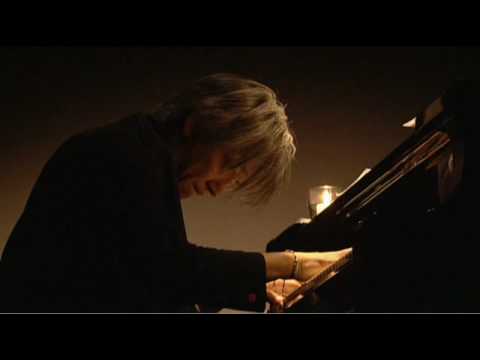
The piano begins alone, and what it offers first is small enough to keep: a spare melodic contour over quiet supporting harmony, clear in the middle register, almost ceremonially unhurried. Nothing crowds it. The left hand settles into a steady arpeggiated ground while the right hand states the phrase as if it already knows it will have to be remembered later—simple enough to hold, open enough to be altered. Early on the line climbs a little, then eases back down into soft chordal resolution; the room around the instrument stays close and dry, so every decay matters.
When the theme returns almost at once, the ear recognizes it less by exact pitch order than by its gait—the same rise and release, now touched with delicate ornament and a slightly fuller voicing. Memory starts working immediately. A lower-register chord sequence briefly darkens the floor without abandoning the pulse; the right hand reclaims the primary motif above it, and the first real dynamic swell lifts the melody before it crests and thins again into resonance. The form is already teaching its own law: the gesture will keep coming back, but never quite as bare furniture.
Through the middle stretch the accompaniment pattern becomes more insistent, a woven arpeggio that carries the line rather than merely underlining it. High notes sparkle briefly above sustained chords; chords themselves expand in depth and spacing; a transitional bridge lets the melody flow without announcing a hard cut. When the principal theme reappears with richer phrasing, the change is audible in the right hand’s longer lyrical reach and in the left hand’s denser support. What was once a solitary statement now rides a fuller harmonic cushion, yet the pulse never hardens into march. Rubato swells and softens the edges so that pressure gathers and releases inside the phrase rather than against it.
A secondary, more pointed melodic idea answers the main material—poignant, slightly more exposed—then yields again. Suspensions hang; the line decays into soft accompaniment and a quiet pedal point before the solo theme restarts with renewed clarity. That restart is the piece’s central act of memory: the same contour, the same patient pacing, but now heard against everything the piano has already layered around it. Arpeggios weave more freely; the upper register traces longer arcs; each return feels less like repetition than like the theme being held up to different light.
Past the two-minute mark the texture settles into a long, stable runway. The grid is clear, the debt low, the body of the sound captured without strain. Here the principal material is no longer introduced so much as inhabited—extended, reharmonized in small degrees, allowed to breathe across wider spans. Phrase drops ease the pressure without breaking the thread; builds gather again without needing new themes. The piano’s agency stays absolute: every swell, every thinned decay, every transfer of the motif from mid-register statement to high lyrical tracing is performed by the same two hands and the same sustaining pedals.
Near the end the pattern loosens. A brief silence opens at roughly 3:47, not as drama but as a small withdrawal; when sound returns it is lighter, already lifting. Weight gathers one last time, then the motor hold itself recedes. The final silence is long and complete—no cadence forced, no last chord left ringing for effect. What remains is the memory of that first spare contour, now inseparable from every transformation it absorbed: the lower darkening, the ornamental returns, the expanded chords, the long runway that refused climax. The form becomes audible only because the ear kept the opening gesture alive long enough to hear how completely, and how quietly, it was changed.
Last updated Aug 14, 2026 · Written with Grok 4.5 · Galdr 0.7.0.dev0 · Inner Ear Gemini 3.5 Flash Lite
Now playing
Merry Christmas Mr. Lawrence
Ryuichi Sakamoto

galdr analysis
Click play to load galdr data.