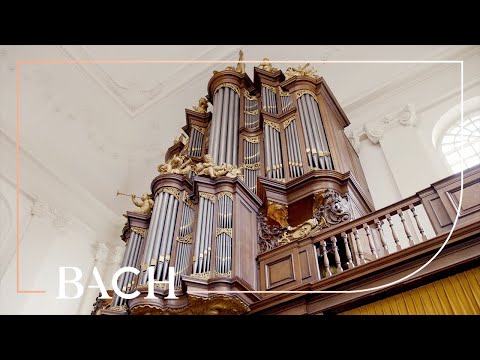
Bach
Passacaglia and Fugue in C minor, BWV 582
Read
Narration sentence highlighting is idle.
A single low organ voice states the ground: eight solemn measures, dark and unadorned, the bass line walking its measured path before anything else is allowed to speak. After a brief held silence the theme returns, and an upper voice answers it—still thin, still grave—so the ear learns at once that this bass will not leave. Everything that follows will be built on its repeated tread.
The variations gather by addition rather than rupture. Mid-register counterpoint weaves through the fixed foundation; registration brightens; the pedals deepen. By the third or fourth cycle the texture has thickened into true polyphony, voices crossing and answering while the ground continues its slow circuit underneath. Sixteenth-note runs begin to cascade over the harmonic frame, then settle into more reflective writing, then thicken again. The pattern holds with almost ceremonial certainty. Around 3:30 the organ swells with fuller stops and deeper bass reinforcement; the room itself seems to answer. Later the voicing thins to a lighter, clearer combination, only to gather once more into chordal weight. One stretch leans into syncopated rhythmic tension inside the polyphony; the next smooths back into legato. The ground never breaks its pace. What changes is the weather around it—density, brightness, how much air the pipes are given, how heavily the lower registers press.
Near 5:54 the full organ arrives with real mass, lower stops carrying the theme like a floor the rest of the sound can stand on. The surface stays harmonic, warm, sustained; there is little percussive strike, only the held pressure of tone filling the space. After that crest the texture clears again, agile and bright, before another grand chordal return. The passacaglia has been doing the same essential work for the better part of ten minutes: stating the ground, dressing it, stripping it, dressing it more richly, always returning the ear to that original low line.
Then, without ceremony, the ground becomes subject. Around 9:44 the fugue begins—same material, now set free into imitation. Voices enter in turn, the subject passed cleanly from one register to another, contrapuntal energy replacing the earlier variation logic. Where the passacaglia held and accumulated, the fugue argues and multiplies. The organ remains the whole world: no other instruments, only pipes answering pipes, the C-minor gravity still present but now in motion rather than procession. Entries stack; the texture thickens toward a final commanding fullness.
In the last stretch the body lock loosens. Attention releases, pressure exhales, and the sound decays into the room’s reverberation—long silence after the final chord, the air still shaped by what has just left it.
Last updated Aug 16, 2026 · Written with Grok 4.5 · Galdr 0.7.0.dev0 · Inner Ear Gemini 3.5 Flash Lite
Now playing
Passacaglia and Fugue in C minor, BWV 582
Bach

galdr analysis
Click play to load galdr data.