Purcell
Dido's Lament
Read
Narration sentence highlighting is idle.
Nothing for the first five seconds. Then low bowed strings, and at 0:08 a soprano who behaves like someone speaking: phrases shaped by breath and words rather than meter, with breath-width silences between them — her line breaks near 0:21 and again around 0:43, while sparse string support continues or hangs underneath. She is talking to Belinda, Thy hand, Belinda, over a sparse, sustained low line that leaves her nearly alone. Time in this opening belongs largely to the voice; a phrase ends when the sentence ends.
The regime changes once the recitative has cadenced, just past the minute mark. The strings take over by themselves, and for the first time something repeats: a short bass phrase that sinks by half-steps to its floor, then starts again from the top. It is stated without any voice above it — the piece teaching its own foundation before the singer returns. This is the material to carry in memory, because nearly everything that follows is this same descent, unaltered, while all the meaning gathers in the one layer free to move.
When the voice comes back at 1:12, it enters a different kind of time. When I am laid floats above cycle-time: her line also tends to fall, so she grieves in the same direction the bass insists on, but freely — holding notes past where the pattern expects, arriving off its grid. The first real swell comes on no trouble around 1:35, more voice and vibrato leaning into the phrase, while the bass underneath has not added a note or lifted one.
The second statement, from 1:53, is the same text over the same descent, and that sameness is what makes it heavier. We already know by now that the loop will not answer her — it will only finish and restart. The words ask that her wrongs cause no trouble for the one she leaves; the strings comply in the harshest way possible, remaining mechanically untroubled. Somewhere in these minutes the repetition stops being something you count and becomes simply the condition of the piece, the floor of the world she is leaving.
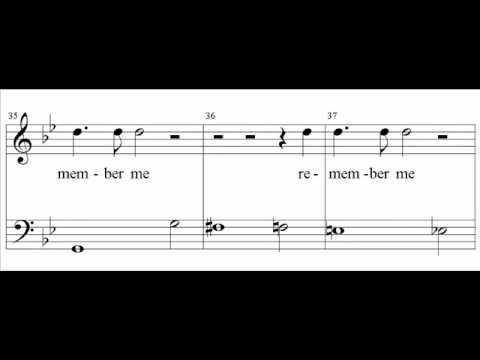
New words arrive at 2:34: Remember me. The plea is fresh vocal material, and the form treats it as something to be worn down. It returns at 3:00, contracts at 3:17 to Remember me alone — the line pared to its one necessary word — then opens again into the full phrase at 3:25, cresting just after with more weight and vibrato than any swell so far. And the line carries its own split: remember me, but forget my fate. The music divides that labor audibly. A bass incapable of not repeating sits on the side of memory; the fate it keeps re-enacting is the half-step fall itself.
The final statement, from 3:42, is the longest and the least assertive — unwinding, dropping back twice, released rather than crested. Her last sound lands just past four minutes, and the strings do not stop with her: the ground keeps stepping for a little while with no one above it, the one moment the accompaniment outlives its singer. Around 4:26 the repeating gives way to a single held chord, which thins through two near-silences before the last resonance goes; by 4:43 the room is empty. The ending is subtraction in stages — words first, then pattern, then sound.
What the form asked you to remember: a bass that never changed, which is exactly why every degree of pressure in the voice registered as pressure at all. And an ending that enacts its text — the motion that defined her lament has to stop before the piece can close.
Last updated Aug 18, 2026 · Written with GLM 5.2 · Galdr 0.7.0.dev0 · Inner Ear Gemini 3.5 Flash Lite
Now playing
Dido's Lament
Purcell

galdr analysis
Click play to load galdr data.