Ex Deo
I, Caligvla
Read
Next narration 0:14
Narration sentence highlighting is idle.
The metal comes in as a march: drums, guitars, and orchestral weight moving together instead of rushing.
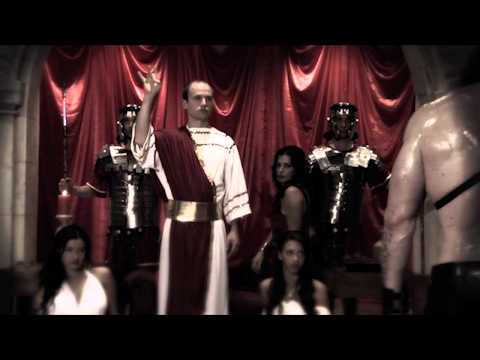
The spoken voice gives the coronation its public shape, naming Gaius Augustus Germanicus as Emperor of Rome.
Now the harsh vocal turns ceremony into blasphemy: Caligvla calls himself god made flesh while the band keeps the march solid under him.
That second line is all possession and threat: fear, colossal might, blood on the hands, delivered like state policy.
The command to bow is blunt, and the steady band makes it feel less like frenzy than enforcement.
The repeated whisper words cut smaller against the heavy arrangement; domination sounds public, not secret.
Life and death arrive as titles he gives himself, with the voice still sitting inside that ceremonial weight.
When the whisper returns as insanity, it is the same repeated gesture turned uglier by the words.
The mother line changes the angle suddenly. The vocal stops sounding only imperial and starts sounding wounded.
The answer to that wound is not softness: he calls himself the true face of Rome, and the song refuses to collapse around him.
The punishment image is explicit now: crucifixion, the Tarpeian rock, public violence spoken as law.
The blood line comes out stripped of argument. He wants it all, and there is no mask left on the demand.
The god-made-flesh claim returns, but after the family wound and execution imagery it lands colder than the first time.
The master-of-fears line comes back too, tying the earlier self-deification to blood and control again.
Everything narrows to kneel. The lyric barely needs grammar anymore; it is just command after command.
Last updated Aug 6, 2026
Now playing
I, Caligvla
Ex Deo

galdr analysis
Click play to load galdr data.