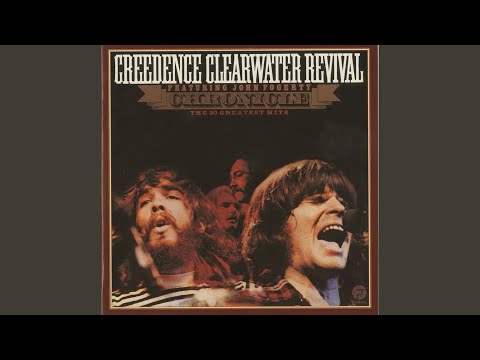
Creedence Clearwater Revival
Fortunate Son
Read
Narration sentence highlighting is idle.
A half-second of dead air, then the guitar riff snaps in — already moving, already insistent. The drums are right behind it, and within two seconds the whole track has found its stride. There is no build-up, no gradual assembly of parts. The rhythm guitar lays down a chugging, circular pattern while the drums lock underneath, and the body is caught immediately — not invited, seized. The pocket is tight but not comfortable. The accents scatter slightly around the grid, leaning into the beat rather than sitting on it, giving the groove a restless, slightly ahead-of-itself quality. Everything is midrange and forward: guitar grit, snare crack, no deep bass weight to settle into. The sound is all surface and motion.
The vocal arrives around nineteen seconds in, rough and pressed, riding directly on top of the riff rather than floating above it. John Fogerty's voice has the same grain as the guitar — compressed, bright, pushing hard against the front of the mix. The band does not thin out to make room. If anything, the density thickens when the vocal enters, because the riff never stops and the drums never ease. The voice functions as another percussive layer, its consonants landing like snare hits, its vowels stretched thin. The lyrics about flags and cannons move past quickly, almost thrown away, because the music refuses to slow down for them. The words ride the motor; the motor does not serve the words.
Through the first verse and chorus, the track sustains a single physical state with almost no variation. Pressure holds steady — the room is neither filling nor emptying, just vibrating at a constant level. Around thirty-eight seconds, a brief weight gathers under the pulse, a momentary darkening, but it lifts almost immediately. The song does not climb. It circles. The riff returns, the chorus returns, the drum pattern returns, and each return confirms that nothing is going to change dramatically. The body stays captured, the grid stays slightly off-axis, and the comfort stays withheld. This is the track's argument: relentless forward motion without arrival.
Near 1:12, the vocal drops out and the guitar takes over — a solo that is less a solo than an extension of the riff, sharper and more sustained but still rhythmically bound. The band does not open up. The drums keep their grip. When the vocal re-enters around 1:30, the third verse lands with the same force as the first, and the accumulated repetition starts to feel like pressure even though the loudness has not changed. The phrase star-spangled eyes cuts through with extra bite, and the answer more, more, more, more hammers the same syllable four times, turning the voice into a percussion instrument.
The final stretch from about 2:00 onward repeats the refrain with increasing compression — it ain't me four times in fourteen seconds, each iteration stacked on the last, the band still driving underneath. Then at 2:09 the pressure releases, the pattern breaks at 2:12, and by 2:15 the body lock lets go. A final chord rings and decays into four seconds of silence. The motor stops without ceremony. The track never gave the body a comfortable seat, and it does not pretend to offer one at the end.
Last updated Aug 15, 2026 · Written with GLM 5.2 · Galdr 0.7.0.dev0 · Inner Ear Gemini 3.5 Flash Lite
Now playing
Fortunate Son
Creedence Clearwater Revival

galdr analysis
Click play to load galdr data.