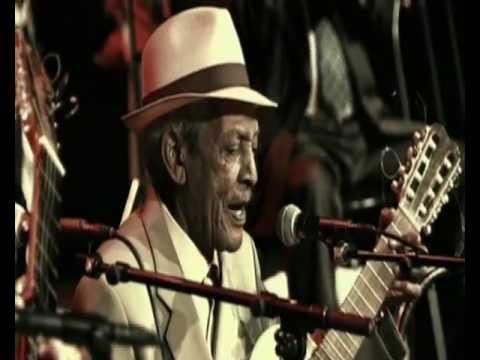
Buena Vista Social Club
Chan Chan
Read
Narration sentence highlighting is idle.
The first twenty seconds are nearly nothing and everything. A guitar picks out a short figure alone, and the silence around it is not empty so much as prepared — the room is being made ready. A second guitar joins, then a soft percussion pulse around ten seconds in, and the groove locks almost before you notice it has arrived. There is no announcement, no count-off, no build. The son pattern is simply there, walking, and the body finds it without being asked.
A trumpet enters around twenty-five seconds, threading a line above the guitars with that unhurried, almost conversational grace — it sings before anyone opens their mouth. It fades as the first vocal arrives near 0:38, a warm male voice settling into the groove like it was always part of it. The vocal sits inside the pocket rather than on top of it. Backing voices arrive in light response, and the texture thickens just enough to feel communal without losing the open air around the lead.
The next stretch stays conversational and unhurried, with the backing harmonies rejoining in soft call-and-response. The rhythm section does not change underneath — the same pulse, the same gentle percussion — but the surface turns gently as voices and instruments pass small bits of emphasis back and forth. Near 1:47 a tres or plucked lead line brightens the warm acoustic floor with a metallic edge. The pattern holds. That is the whole story of this stretch: the groove does not waver, and the ensemble keeps its restraint.
The middle of the track is a long, settled ride. The harmonic surface barely shifts. Weight gathers briefly around 1:42 as the vocal moves through the Juanica y Chan Chan verse, and again near 3:40, but these are not surges — they are the sound leaning slightly forward, the low end pressing a touch more, then easing back. The accent drift is real: attacks walk around the beat grid rather than nailing it dead center, and that is what gives the pocket its living, breathing quality. The body is captured but never rigidly pinned. You settle into it rather than being locked.
The final minute brings the trumpet back, weaving above the vocal refrains, and the texture thickens as voices layer more closely. Around 4:26 the phrase turns one last time, and then the hold loosens — the percussion recedes, the guitars thin, and the pattern breaks apart in a sequence of small fractures between 4:31 and 4:34. What remains is a clean chord resolving into room reverb, and then silence. The ending is not a collapse. It is the groove simply letting go, the way a hand opens after holding something steady for a long time.
Last updated Aug 15, 2026 · Written with GLM 5.2 · Galdr 0.7.0.dev0 · Inner Ear Gemini 3.5 Flash Lite
Now playing
Chan Chan
Buena Vista Social Club

galdr analysis
Click play to load galdr data.