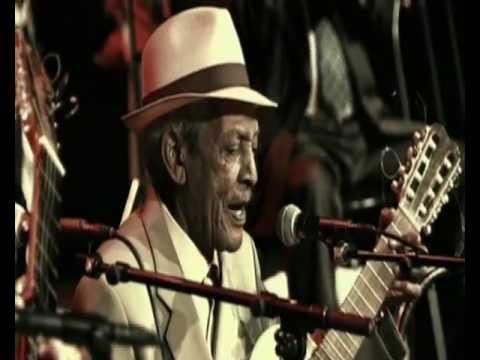
Buena Vista Social Club
Chan Chan
Read
Narration sentence highlighting is idle.
A lone acoustic guitar opens the room with an easy, unhurried strum, already walking before anyone else arrives. Soft percussion settles underneath, then the rest of the acoustic band gathers into a steady Cuban son pocket—light on its feet, warm in the midrange, nothing forced. By about 0:23 the groove has the body without grabbing hard: a settled seat you can inhabit for a long stretch. A trumpet slides in soon after, graceful and unhurried, then steps aside so the guitars and pulse can keep the road open.
The lead voice enters conversational and dry-warm, mapping a simple circuit: De Alto Cedro voy para Marcané, then on toward Cueto and Mayarí. The band does not dramatize the itinerary; it just carries it, call-and-response voices answering like company on the same path. The refrain returns with the patience of something already known, the surface staying open and harmonic while the pulse holds its elastic little lean.
When the lyric turns toward affection that cannot be denied, the pocket stays easy—no swell to match the confession, no brake either. Desire rides the same unhurried motor. Later the story of Juanica and Chan Chan sifting sand by the sea lands inside that same calm propulsion; the music neither undercuts the vignette nor inflates it. A tres line takes a melodic walk over the rhythm section around 1:47, bright and wiry, then the voice re-enters as if the road never broke. Another verse asks the path cleared of straw so someone can sit on a trunk up ahead—travel talk again, plain and physical, while the groove keeps its comfortable capture.
The refrain comes back in cycles, each return recognizably the same route, only a little thicker with answering voices and the band’s quiet insistence. Late in the track the trumpet returns with soaring counter-lines, thickening the air without overturning the pocket; voices and brass braid through the final passes of the place-names. Pressure never really climbs toward rupture—it sustains, releases in small exhales, and stays companionable.
Near 4:28 the bodily hold loosens. The pattern frays in soft breaks, instruments thin to guitars, and the last chord resolves cleanly into room air and silence. The journey simply stops mid-circuit, as if the next town is still out there and the music has already done its part by walking you this far.
Last updated Aug 15, 2026 · Written with Grok 4.5 · Galdr 0.7.0.dev0 · Inner Ear Gemini 3.5 Flash Lite
Now playing
Chan Chan
Buena Vista Social Club

galdr analysis
Click play to load galdr data.