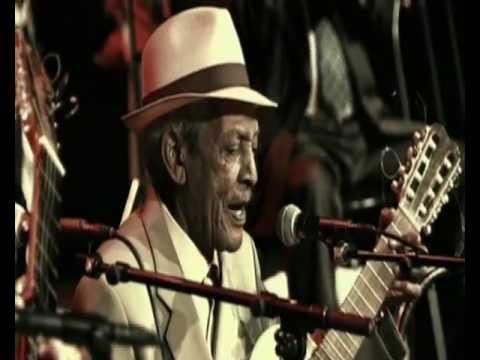
Buena Vista Social Club
Chan Chan
Read
Narration sentence highlighting is idle.
0:00–0:37 Introduction
Acoustic guitar opens over silence, percussion enters near 0:10, and the ensemble locks into a Cuban son groove by roughly 0:15. A trumpet line weaves through around 0:25 and exits before the voice arrives. The section establishes the rhythmic contract and pocket the whole track will inhabit.
0:37–1:18 First refrain block
Lead vocal enters with the signature refrain — De Alto Cedro voy para Marcané / Luego a Cueto voy para Mayarí — repeated three times. Backing harmonies join in call-and-response on the second and third passes. The section introduces the voice and proves the refrain as the song's home material.
1:19–2:29 Verse cycle
Three narrative verses unfold in sequence: El cariño que te tengo, Cuando Juanica y Chan Chan, and Limpia el camino de paja. Each four-line verse shifts lyric perspective while the band maintains the same groove. Harmonies enter and exit around the lead, keeping the verses from settling into a single texture. A brief tres solo bridges the second and third verses near 1:47.
2:29–2:55 Refrain return
The refrain returns three times, restoring the song's opening lyric block after the verse cycle. The pocket holds; the section's job is to re-establish the refrain as structural anchor before the track withdraws from vocals.
2:55–3:55 Instrumental interlude
Vocals drop out for roughly a minute. The band sustains the groove with instrumental foreground, including a trumpet return that builds density. The section delays the final refrain and lets the pocket carry the form without the voice.
3:55–4:40 Final refrain and close
The refrain returns three more times, trumpet threading counter-lines through the vocal harmonies. After the last refrain at 4:18, the pattern breaks at 4:26, motor hold loosens at 4:28, and the ensemble resolves into a clean terminal decay by 4:34, followed by silence to 4:40.
The form is a refrain–verse–refrain cycle whose instrumental interlude proves the groove can carry the song alone before the voice returns for a final, denser refrain pass.
Last updated Aug 15, 2026 · Written with GLM 5.2 · Galdr 0.7.0.dev0 · Inner Ear Gemini 3.5 Flash Lite
Now playing
Chan Chan
Buena Vista Social Club

galdr analysis
Click play to load galdr data.