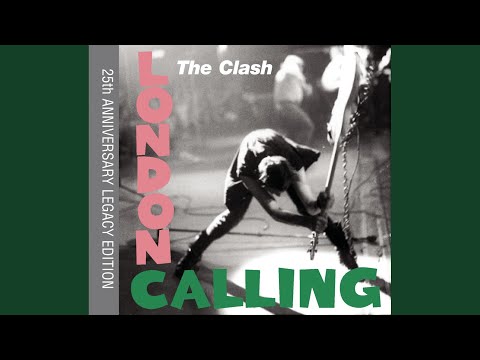
The Clash
London Calling
Read
Narration sentence highlighting is idle.
The opening is already moving before the room has finished settling: a lone electric guitar bends and wails in the first seconds, siren-like, before the clipped strokes take hold. Around six seconds in, the full band enters beneath it, not as a swell but as a single motor taking hold—tight snare on the backbeat, kick marking the floor, the low string riding close enough to the pulse that the body finds its seat within the first bars. The surface stays open and percussive; nothing dense crowds the midrange yet. What arrives is forward motion itself, a settled pocket that seizes without bracing.
Around the twenty-second mark the voice cuts in as another hard surface: dry, shouted, close-miked, riding the grid rather than floating above it. The grain is chest-forward and slightly frayed at the edges, each phrase landing like another attack layered onto the guitars. The band does not thicken so much as it continues; the same motor keeps driving while the vocal pressure simply occupies the front of the mix. Weight lifts and gathers in short waves under that pulse—bass and kick briefly more present, then easing—never enough to break the held state, only enough to keep the floor breathing.
The groove stays captured and comfortable for long stretches, a martial forward command that refuses to hurry or drag. Guitar chords stay sharp and mid-bright; the drums keep their dry snap; the bass holds a steady low placement that gives the body somewhere to sit without ever turning heavy. When the vocal lines lengthen or stack into brief harmony later, the change is textural more than structural: extra grain and presence bite stacked onto the same driving shape, the pocket still intact, the surface still more strike than wash.
Past the two-minute mark the same engine keeps turning. Occasional lifts in low-end weight come and go beneath the vocal, small rises that never tip the track into drag. The pattern holds so cleanly that the ear starts to live inside the repetition itself—the clipped guitar strokes, the snare’s regular return, the voice’s hard re-entries—until the final stretch begins to thin. Attention loosens, the body lock eases, pressure releases. A last shouted refrain pushes against the band, then the whole machine cuts away. What remains is a single guitar chord ringing out into emptying space, its decay the only motion left, fading until the room is quiet.
Last updated Aug 17, 2026 · Written with Grok 4.5 · Galdr 0.7.0.dev0 · Inner Ear Gemini 3.5 Flash Lite
Now playing
London Calling
The Clash

galdr analysis
Click play to load galdr data.