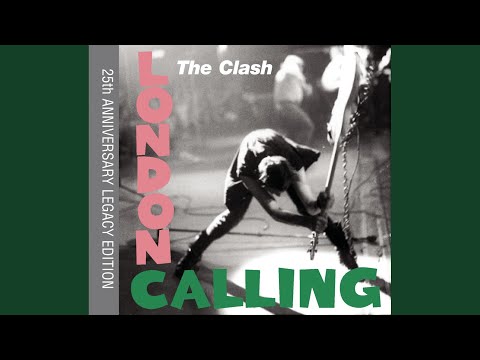
The Clash
London Calling
Read
Narration sentence highlighting is idle.
The song starts with a lone, siren-like guitar wail. Around 0:06 the full band drops in behind it, and the step is set: quick, even, faintly martial, a bass line that keeps circling down and restarting like a hand turning a crank. Nothing in the next three minutes will speed it up or slow it down. That's the contract of the record — not a build toward a payoff but a groove at full conviction once the band enters, with room left at the front of it for a voice to shout over.
Strummer comes in at 0:21 and he isn't so much singing as announcing — a hoarse, forward-leaned bark, disaster bulletin delivered at street-corner volume. His phrasing shoves at the edges of the beat while the drums decline to be hurried, and that small friction between a voice in a rush and a rhythm that won't be is most of the song's tension; it never needs resolving. The words are all sirens and mobilization — faraway towns, war declared, the underworld called out of hiding — with one great swipe of cleanup in phony Beatlemania has bitten the dust.
When the verses give way to the chant, the catalog of catastrophe only makes the music more comfortable. Ice age, meltdown, engines stopping, wheat running thin — each item lands on the same unhurried step, and the refrain arrives like someone reading a weather report: London is drowning and I live by the river. No tremor in it. The fatalism is the hook; the doom is danceable, and the pocket actually deepens as the news gets worse.
After the second chorus the words step aside and the band simply rides — a long instrumental stretch of the riff turning over on itself, wordless voices threading through in oohs, no lift and no sag. It's the engine room on display: the track's idea is maintenance, and close to thirty seconds of pure riff prove the pulse doesn't need lyrics to carry you. So when the chant returns at 2:19, it lands heavier, less like a warning than like something already true, and then the band rides again.
Now get this — Strummer clears a path into the last verse, and the aside is the closest the song comes to a wink. Yes, he was there too; some of what they said was true; after all this, won't you give him a smile. Gallows charm over ground that hasn't shifted an inch, and then the exit: the closing thought — that he's never felt so much like everything else — repeats until the words wear down into pure rhythm, a skipping stone of a line.
In the last seconds, around 3:13, the band releases its grip and the sound empties out, leaving a single chord hanging in the room, ringing after the rhythm is gone, thinning until only the decay itself remains. The march stops; the sound outlives it by a few seconds. That ringing chord is the last fact the record offers, and it's enough.
Last updated Aug 17, 2026 · Written with GLM 5.2 · Galdr 0.7.0.dev0 · Inner Ear Gemini 3.5 Flash Lite
Now playing
London Calling
The Clash

galdr analysis
Click play to load galdr data.