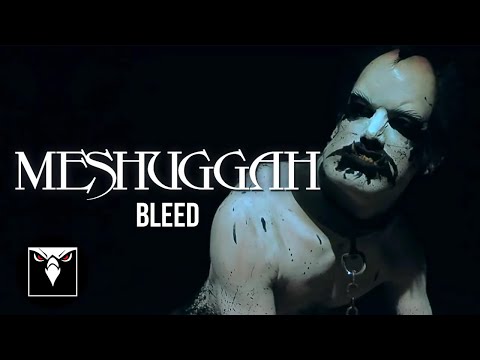
Meshuggah
Bleed
Read
Next narration 0:00
Narration sentence highlighting is idle.
Tiny breath of air, then guitar and drums hit as one tight low machine—fast, clipped, almost no bloom.
That pulse already has the body. There’s a place to sit, but the accents keep sliding the seat under the count.
Voice comes in rough and close—not above the band, another face of the same attack. “Beams of fire.”
“Only agony” gets forced through the same rhythmic teeth. No melodic soft landing—just consonants dragged into the riff.
Guitars keep chopping the air into fixed pieces while the drums make those pieces feel slightly displaced.
Crimson liquid, ruby fluid—the images stay bodily and wet, but the band never opens a release valve.
Still the same clenched low color. Small angle shifts, same iron edge, body correcting itself while it’s carried.
“Salivating red at the prospect of my ruin”—then the voice steps aside and the riff keeps stuttering on its own.
That kick flutter is relentless, but the larger cycle stays readable. You’re living inside recurrence now.
Voice back: “Malfunction the means for its ascent.” The band answers by refusing ordinary expressiveness—repetition is the expression.
Bloodletting, a stringent voice beckoning—still locked in that narrow channel, dense and disciplined.
“So futile any resisting tension.” The surface has warmth in its mass, but the front edge is all bite.
Death-induced mechanics—the lyric is naming what the pattern has been doing to the body for minutes.
Device of extinction, terminating clockwork. The phrase almost feels redundant—the band has been clockwork since the first hit.
End-art instruments, lethality attained—still no broad dynamic lift, just exact returns under the words.
“Heed, it commands, heed my will.” An order spoken through a human throat while the band stays brutally exact.
And there it is—“Bleed, it says, bleed you will.” The title lands as programming more than confession.
After the command the machine just keeps running. Same clipped attacks, same refusal to loosen.
Now the pressure starts to withdraw. Not a collapse—more like part of the forward wall getting cut away.
Pulse is still there, but the hold changes. Sound drains from the central channel while attention stays caught.
A late tightening—one more pull of motion before it lets go.
Blunt stop. The grid drops out and the room goes empty—no soft tail, just the absence of that pounding pattern.
Last updated Aug 13, 2026 · Written with Grok 4.5 · Galdr 0.7.0.dev0 · Inner Ear Gemini 3.5 Flash Lite
Now playing
Bleed
Meshuggah

galdr analysis
Click play to load galdr data.