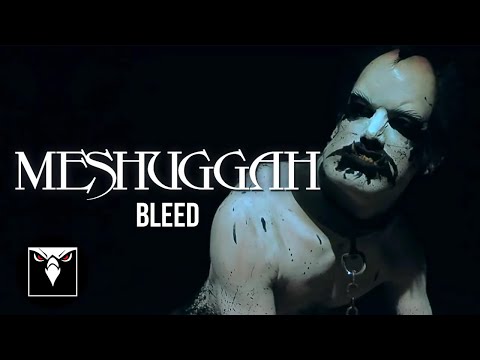
Meshuggah
Bleed
Read
Narration sentence highlighting is idle.
A second of nothing, then a low grow filling the space — not a riff yet, just pressure gathering in the dark. By 0:05 the floor drops in: down-tuned guitar and double kick drum locking into the pattern that will carry almost the entire track. What's striking isn't the heaviness alone but the immediacy of the lock. The body finds the pulse almost before the ears have finished identifying the sources. Guitars and drums arrive fused, already breathing as one mechanism, and within a few seconds the groove has settled into its relentless staccato churn — that now-iconic ostinato where the picked guitar pattern and the kick drum fire in tight, hypnotic unison, repeating with a precision that feels more mechanical than human.
Jens Kidman's voice enters around 0:27, and the first image is already bodily catastrophe: beams of fire sweep through my head. His delivery is a sustained shout — not the high scream of some extreme metal, not a growl, but a pressed, mid-range bark that sits on top of the groove like another rhythmic layer. The words describe a body being consumed from within, a microscopic nemesis propagating through blood and nerve, and the music underneath refuses to offer any counterpoint of relief. The pattern holds. It does not build toward a chorus, does not open into a bridge, does not breathe. The vocals ride the surface and then withdraw, and the groove keeps grinding.
That withdrawal is the track's structural logic. Vocals enter, deliver their catalogue of internal destruction, and exit — and each time they leave, the instrumental pattern remains, unchanged in its essential shape. Around 1:00 the voice drops away and the double-bass-and-guitar mechanism continues alone, and the absence of the voice makes the groove sound even more relentless, as though the human element was the only thing softening the machine. When the vocals return, they rejoin the same pattern, not a new one. The track's refusal to develop in any conventional sense is its central tension: four minutes of the same rhythmic cell, sustained with only the vocal layer cycling in and out.
The lyrics accumulate their own grim momentum through this repetition. By the midpoint the imagery has moved from pain to mechanism — death-induced mechanics propel its growth, the terminating clockwork of my gleeful bane — and the words and music are doing the same thing after all. The groove is the clockwork. The voice is the body being consumed by it. There's no resistance between lyric and sound because the sound is the thing the lyrics describe: a self-generating, self-propelling machine that will not stop.
Near 3:29 the vocal commands arrive: Heed, it commands, heed my will. Then the title line: Bleed, it says, bleed you will. The words continue into a final verse — falling, clarity of undoing, taunting whispers, a sneering grin — but the recording is already beginning its long exhale. Around 4:19 the pressure that has been held for over four minutes starts to release. The groove loosens its grip. Weight shifts, the phrase drops back, and for the first time the pattern feels like it's running down rather than running on.
Then a clean severance. The band cuts to a lingering feedback decay around 4:55, and within seconds the sound empties to silence. No final chord, no ritard, no dramatic last breath — just the machine switching off, leaving a dark hum and then nothing. The abruptness is honest. After four minutes of refusing to stop, the track doesn't pretend it chose to end. It simply stops.
Last updated Aug 13, 2026 · Written with GLM 5.2 · Galdr 0.7.0.dev0 · Inner Ear Gemini 3.5 Flash Lite
Now playing
Bleed
Meshuggah

galdr analysis
Click play to load galdr data.