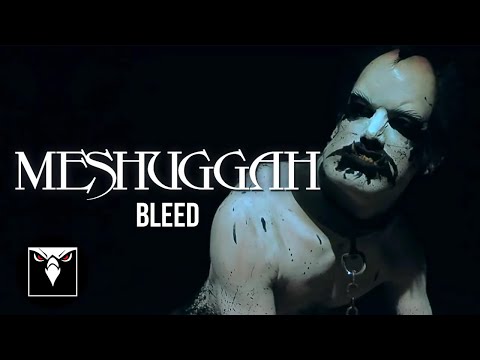
Meshuggah
Bleed
Read
Narration sentence highlighting is idle.
The first couple of seconds are not empty so much as braced: silence holds the doorway, then a low rumble begins to lift out of it. The track does not spend long in atmosphere. Within a few seconds the double-kick pattern and down-tuned guitar figure lock into a hard, fast machine, the kind of riff that feels less like a swing than a conveyor belt with teeth. Its weight is real, but it is not a slow drag; the pressure comes from speed, repetition, and the way the low guitar attack keeps snapping back into the grid.
Once the groove has settled, around 0:10, the recording becomes fiercely consistent. The kick drums keep drilling, the guitars chug in clipped blocks, and the whole surface stays dense without becoming blurry. There is a little lateral friction in the attacks — the accents do not all sit politely in one place — but the pulse itself remains brutally usable. The body can find the seat in it, even if the seat is made of metal. That is the particular grip here: not chaos, not sprawl, but a tight repetitive hold that makes anticipation physical.
The harsh vocal arrives near 0:24 as another forward edge rather than a separate spotlight. It presses into the same packed space, dry and abrasive, riding above the riff without loosening it. The voice has a shouted grain, but the band’s motion is already so fixed that the vocal reads as extra bite on an existing mechanism. Lines come in short windows, then leave enough room for the riff to show that it was never dependent on them. When the vocal drops away after the early run, the drums and guitars do not open into relief; they keep hammering, and the absence simply exposes how much of the track’s force was already in the repeated pattern.
That long middle stretch works by refusal. Re-entries of the voice add pressure at the front of the mix, but the deeper pleasure is the unbroken runway underneath: double bass, chug, double bass, chug, with small shifts of attack and density doing more than any dramatic sectional break. Around the second minute and again later, the vocal returns feel like a rough surface being dragged across the top of a moving belt. The harmonic field stays comparatively warm and anchored, so the ear is not pulled through big chord drama; it is pinned by rhythm, timbre, and recurrence.
Past 3:00 the track is still committed to the same physical argument. The dense guitar-and-drum body keeps its shape, and the vocal passages stack more abrasion into a texture that has already trained the body to expect no mercy from the pulse. Because the arrangement does not keep throwing huge new entrances at the listener, the smaller things start to matter: the tightness of the kick pattern, the squared-off guitar attacks, the way the vocal grain sits forward without swallowing the low machinery.
The release begins around 4:19, not as a grand collapse but as pressure easing out of the long-held drive. The pattern still has enough shape to carry the body for a while, then the track thins toward the end. At 4:55 the machine cuts away into terminal silence and decay, leaving the last fact of the recording very plain: after nearly five minutes of rigid forward motion, the body’s grip is simply taken off.
Last updated Aug 20, 2026 · Written with GPT-5.5 · Galdr 0.7.0 · Inner Ear Gemini 3.5 Flash Lite
Now playing
Bleed
Meshuggah

galdr analysis
Click play to load galdr data.