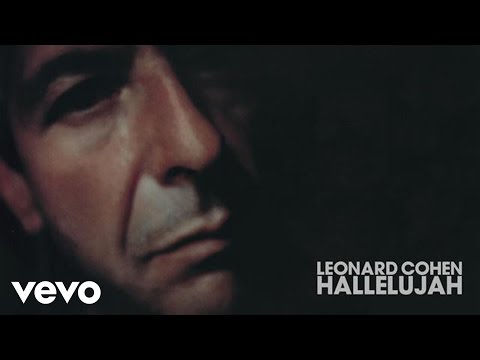
Leonard Cohen
Hallelujah
Read
Narration sentence highlighting is idle.
The recording waits less than a second before the clean guitar starts picking its way into the room, small and dry enough that each chord feels placed by hand. Cohen’s voice enters low at 0:04, not floating above the accompaniment so much as settling into the same narrow band of warmth. The bottom is only lightly marked at first; the pulse is there, but it does not grab with a dance-floor grip. It sways, steady and usable, while the guitar keeps the surface open around him.
As the first verse moves, the arrangement begins adding weight without making a spectacle of it. Around the line about the fourth and fifth, the harmony and rhythm gather a little more body; light drums and bass become audible as support rather than a dramatic entrance. The sound starts to lean forward. By the first Hallelujah refrain, near 0:40, the room widens: backing voices rise behind Cohen, the band thickens, and the title word turns from a phrase in one throat into a held communal surface. The pulse stays straight, almost ceremonial, letting the swell feel broad instead of frantic.
The first release is just as important as the swell. Around 0:55 the texture thins back to voice and guitar, and the sudden space makes Cohen’s delivery feel closer again. Nothing collapses; the pattern simply returns to its smaller frame. That reset becomes the song’s physical habit: verse as a narrow corridor, refrain as a larger chamber, then the narrowing again. The body learns the cycle quickly, waiting for the backing voices before they arrive, feeling the drums and bass come in as a slow filling of the floor rather than a shock.
In the second verse, the accompaniment carries more memory of the earlier chorus. The drums and bass enter gently under the vocal, and the voice presses a little harder into the consonants without losing its measured, almost spoken grain. When the chorus opens again around 1:36, the backing voices do not merely decorate Cohen; they soften his rough edge by surrounding it. The band’s steady motion gives the refrain a held weight, suspended rather than heavy, as if the sound is being kept aloft by repetition.
The middle stretch keeps tightening and easing by the same means. After another strip-back near 1:55, the guitar’s clean pattern is exposed again, but the ear now hears it as preparation. The phrase about the holy and broken word arrives over a support that gathers in stages, and the chorus at about 2:17 blooms with more certainty because the track has trained the body to accept that widening. The harmony is warm, the surface mostly smooth, with the percussive edge tucked underneath the sustained voices and tonal mass.
The final verse begins in a smaller space again, Cohen close and worn into the groove, the guitar ticking beneath him. When the band and choir return near 3:59 for the last large refrain, the re-entry feels earned by the long, steady runway before it. The arrangement does not explode; it fills, holds, and keeps moving with a firm, plain pulse. Repeated Hallelujahs become a kind of rotating weight, voices layered enough to make the word less like a climax than a sustained object in the room.
Past 4:15 the pressure starts to let go. The voices and instruments continue, but the sound is already withdrawing, the edges softening into fade. Brief gaps and phrase-end drops loosen the motor hold until, around 4:31, the pattern finally gives way. What remains is not a final struck ending but a decay: the last trace of guitar and room tone slipping into silence, the steady body of the track released rather than broken.
Last updated Aug 17, 2026 · Written with GPT-5.5 · Galdr 0.7.0.dev0 · Inner Ear Gemini 3.5 Flash Lite
Now playing
Hallelujah
Leonard Cohen

galdr analysis
Click play to load galdr data.