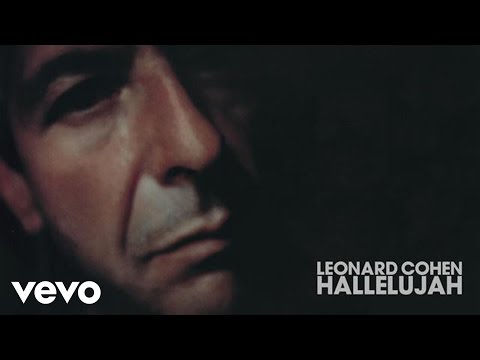
Leonard Cohen
Hallelujah
Read
Narration sentence highlighting is idle.
A clean electric guitar opens in a small, dry space, not quite alone for long: the pulse is already dependable, but the sound is thin enough that Leonard Cohen’s voice can enter at 0:04 like someone beginning a story across a table. He does not sing the “secret chord” as revelation. He almost talks it, low and wry, letting the line about David and the Lord sit beside the little picked pattern without any halo around it. When the lyric starts naming its own harmony — the fourth, the fifth, the minor fall, the major lift — the music does not turn theatrical. It simply keeps moving, plain and squared-off, so the joke and the prayer share the same chair.
The first sustained arrival comes with the refrain. Around 0:40, the backing voices widen the room on Hallelujah, and the track’s modest machinery suddenly matters: light drums, bass, guitar, and those arranged harmonies make a steady ceremonial sway out of what had been almost conversational. It is not a rupture; it gathers. The pulse has a soft motor grip, regular enough to carry the body, but the surface stays warm and open rather than crowded. Cohen remains low inside it, less lifted by the chorus than surrounded by it, as if the word is too large for one voice and too compromised to belong only to a choir.
The second verse returns to sparseness at about 0:59, and the changed return is immediate: the same guitar-led steadiness now has the memory of the chorus behind it. The biblical scene turns erotic and violent, but Cohen’s delivery barely raises its temperature. That restraint is the point of the friction. The words move through overthrow, tying, broken throne, cut hair; the band waits, then admits more body under him as the verse thickens. When the refrain comes back, the voices do not cleanse the story. They make the extracted word feel public, almost automatic, drawn from the mouth after power has already changed hands.
The song’s most Cohen-like shrug arrives in the next verse: I don’t even know the name lands over the same settled pulse, and the arrangement lets the blasphemy feel oddly calm. Nothing in the rhythm panics; nothing in the harmony insists on a single clean moral center. Then the line about the holy or the broken Hallelujah tightens lyric and music beautifully. The chorus has always sounded capable of grandeur, but by now its grandeur is stained by repetition. Each return is recognizably the same swell, the same reliable rise, yet the word carries more damage because the verses keep changing what kind of utterance it can be.
After the pullback near 2:48, Cohen starts from a more exposed place: I did my best, it wasn’t much. The guitar and light support give the confession room before the drums and bass gather again underneath him. His voice does not plead; it measures the failure in a low register, almost dry-eyed, and that makes the later lift stronger. When he reaches the “Lord of song,” the phrase feels less like a courtroom defense than a final accounting made in rhythm. The backing voices re-enter for the last long stretch, and the steady beat turns the repeated hallelujahs into endurance rather than climax alone.
Past 4:15 the pressure begins to loosen. The harmonized refrain continues over the measured drum pattern and guitar strum, so the fade thins the sound into an outline instead of giving it a final seal. There is no last dramatic stamp, just a gradual withdrawal until the motor hold lets go around 4:31 and the final decay gives way to silence. The song ends as if the word has outlasted the singer for a few seconds, then finally loses its body too.
Last updated Aug 17, 2026 · Written with GPT-5.5 · Galdr 0.7.0.dev0 · Inner Ear Gemini 3.5 Flash Lite
Now playing
Hallelujah
Leonard Cohen

galdr analysis
Click play to load galdr data.