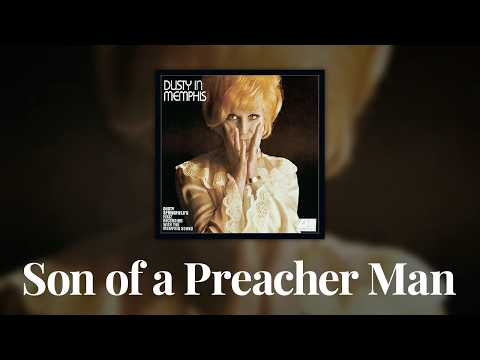
Dusty Springfield
Son of a Preacher Man
Read
Narration sentence highlighting is idle.
The track opens already walking. Organ curls a bright, clipped figure over a lean bass line and a dry, unhurried drum kit—hi-hat ticking, snare placed with quiet certainty. Nothing rushes. The pocket sits light and forward, a motor that catches the body without pressing hard, more invitation than shove. Space stays open around the instruments; the low end is present but not heavy, just enough floor to keep the step honest.
Dusty’s voice slides in close and smooth, grain soft at the edges, riding the groove rather than punching through it. She sits right in the pocket the band has already set, her phrasing easy and slightly behind the beat, as if the air itself is carrying her. The organ keeps flickering underneath, a warm, reedy color that never crowds her. When the backing voices arrive they thicken the middle without clutter—short, breathy answers that open the room sideways and then settle back into the pulse.
Around the first hook the horns step forward in short, bright stabs. They don’t swamp the mix; they punctuate, lifting the surface for a few bars and then easing off so the rhythm section can breathe again. The groove never loses its hold. Bass and drums stay locked in that same moderate walk, accents leaning just enough around the grid to keep the body circling rather than marching. Pressure builds only gently—more a sustained forward lean than any sudden weight—and the surface stays open, harmonic warmth carrying more of the load than hard percussive edge.
Later verses keep the same architecture. Horns return in short bursts, backing voices swell and thin, Dusty’s lead stays intimate and forward, sometimes stretching a syllable until it almost floats free of the beat before dropping back into the pocket. The arrangement never crowds; every entrance is a temporary thickening, every recession a return to that spare, swinging core. Even when the full band gathers near the end—horns, voices, organ, rhythm all present—the density still feels chosen rather than piled on. The pulse remains the true center of gravity.
In the final stretch the whole shape simply begins to empty. Voices and horns ride a little longer, the groove loosens its grip, and the track fades while the motor is still turning, leaving the last traces of organ color and distant harmony dissolving into quiet.
Last updated Aug 15, 2026 · Written with Grok 4.5 · Galdr 0.7.0.dev0 · Inner Ear Gemini 3.5 Flash Lite
Now playing
Son of a Preacher Man
Dusty Springfield

galdr analysis
Click play to load galdr data.