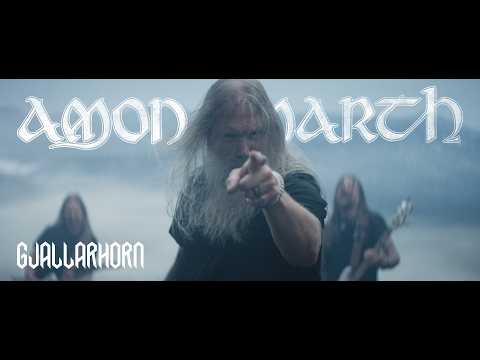
Amon Amarth
Gjallarhorn
Read
Narration sentence highlighting is idle.
Half a second of dead room, and then a low drone rising out of it. Brass-like swells roll over that drone in slow dark waves, a horn line threading through the middle, synth mass holding underneath — nothing rushes, and the pressure fills from the back rather than attacking from the front. The introduction spends most of a minute assembling weight it hasn't yet shown, and the waiting itself turns physical.
Just before the half-minute mark the promise is kept all at once: a distorted guitar riff and double-kick drums arrive together and displace the orchestral dark without a crossfade. From there the track barely changes loudness again — what changes is rate and texture. The kick drums run in fast, even strokes; the guitars chug in tight synchronized blocks; the grid under it all is so steady it feels machined. And yet the riff accents lean across the barline instead of landing square on it, a drift that gives all that precision a bit of swagger — a pocket you can actually sit in, not just be dragged by.
The voice surfaces just before the minute mark, and it behaves less like a singer than like one more distorted instrument: guttural, loaded into the midrange, phrased in growled bursts of two or three seconds with quick breaths between, snapping into the riff's blocks the way percussion would. It deepens the grind at the front of the mix without opening anything up.
Twin guitar lines begin harmonizing past the ninety-second mark, and melody starts competing with rhythm for the foreground. The first full instrumental break arrives at 2:03 — the growls step aside and a high, screaming lead takes over the entire front of the mix, the kick drums churning beneath it without a flicker — and when the voice returns a dozen seconds later, the wall it lands on is thicker than the one it left.
Changes of gait do the work that dynamics would normally do, because the loudness itself hardly moves. Around 2:24 the tempo steps down into a driving mid-tempo lope and the body gets to lean instead of sprint; a few bars later the double-kick opens back up to full speed. The deeper give is the breakdown at 3:46, where the harmony guitars tip into a slowed, crushing stomp — for the first time there is open air after each strike, room to hear the size of a hit, the voice riding across the change without a seam. Past four minutes the pace climbs again.
The last stretch is the most comfortable the track ever gets: the pocket at its easiest, one more screaming lead let loose, two final blocks of growl, and a pile-up that crests in the closing seconds. Then the ending is a fact, not a fade — one last heavy chord lands around 5:08 and is cut off clean instead of ringing out, everything severed at once, and the couple of seconds of true silence that follow simply confirm that it's finished.
Last updated Aug 20, 2026 · Written with GLM 5.2 · Galdr 0.7.0 · Inner Ear Gemini 3.5 Flash Lite
Now playing
Gjallarhorn
Amon Amarth

galdr analysis
Click play to load galdr data.