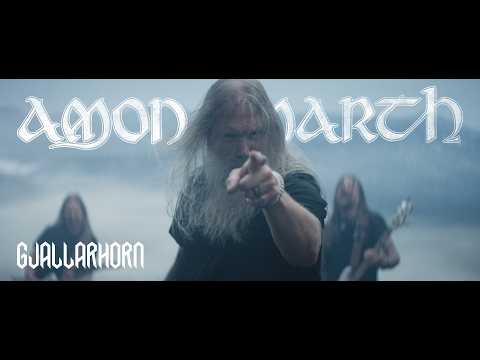
Amon Amarth
Gjallarhorn
Read
Narration sentence highlighting is idle.
The first half-minute opens like a gate being hauled up in the dark: low rumble, horn-like brass, and a sustained cinematic swell holding the room before the metal band is fully in it. The pulse is already implied, but it is not yet the riff’s possession; it feels ceremonial, a signal flare across ice. When the distorted guitars and double-kick drums enter around 0:28, the track snaps into Amon Amarth’s real weather: fast, squared-off, and strongly patterned, with the rhythm section giving the body a usable seat even as the surface turns dense and abrasive.
Johan Hegg’s growl comes in over that wall as the lyric begins its trek through Nifelheim. The story is cold and mythic, but the music refuses to drag its feet with the wanderer. The words speak of weary legs and piercing wind; the band answers with forward command, guitars locked to the drums rather than sagging under the journey. That resistance matters. The song is not illustrating exhaustion so much as driving through it, making the path feel inevitable because the riff keeps its shape.
The first big vocal refrain gathers around the well: Let me drain it down, then wisdom fill my soul. Under it, the guitars keep a melodic-death-metal brightness inside the churn, not bright in mood but bright in edge, with harmonized lines cutting across the low push. Around 1:57, the low body of the track feels more firmly gathered beneath the moving pulse, and the repeated plea starts to feel less like a request than a demand being forged by repetition. The band does not release much pressure; it sustains, turns, and keeps marching.
When Mimr refuses to be swayed, the music stays almost cruelly steady. The lyric tightens around stillness — the guardian not moving, not turning — while the drums and guitars continue their motor discipline, so the scene’s immobility sits inside motion instead of stopping it. Later, as Oden offers any price, the harmonic color and guitar movement give the section a little more lift, enough to make the bargain feel close without loosening the grip. By the exchange at 3:51, Your eye is my price lands plainly because the track has spent minutes proving how little room there is for hesitation.
The best theatrical stroke is how calm the crucial answer is. Give me a knife does not need the band to collapse around it; the steadiness is the point, voice and riff aligned in a brutal kind of resolve. After 4:36, the refrain returns changed by the cost now named. The same pool, the same wisdom, the same charging pulse — but the words no longer sound like aspiration. They sound transactional, paid for in flesh. The final stretch keeps the double-kick and guitars driving until the pressure releases near 5:08 and the pattern breaks into a hard cutoff, leaving only silence where the march had been.
Last updated Aug 14, 2026 · Written with GPT-5.5 · Galdr 0.7.0.dev0 · Inner Ear Gemini 3.5 Flash Lite
Now playing
Gjallarhorn
Amon Amarth

galdr analysis
Click play to load galdr data.