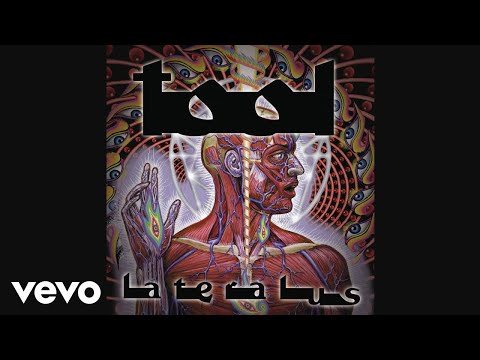
Tool
Lateralus
The opening guitar figure draws a shape before the song asks for belief. It is patient, angled, and repeated with enough force to feel like a diagram being traced by hand. The pulse is steady, but it is not simple comfort. Each return lands in a familiar place while the accents lean around it, so the listener can follow and the mind still keeps making small corrections. The track takes time away from the clock and replaces it with a pattern that has to be inhabited.
When the voice enters at 1:38, the lyric begins with perception narrowing into color and then widening toward contact. The arrangement answers that sequence by staying reduced, controlled, and almost severe. More is seen, but the frame does not dissolve. By 2:05, the words press above, below, beyond, and against the line of reason; the band hears that literally. The riff keeps drawing a boundary, then making the boundary flex.
At 2:34, the warning about overthinking separating body from mind lands because the track has already made that problem physical. This is music that invites counting, tracking, and solving, while the groove keeps insisting on bodily capture. The song lets both impulses remain true. I can feel the analysis working at the edge of the beat, then feel the drums and bass pull the thought back into muscle.
The 2:50 return is not just a repeat of the color cycle. It answers the overthinking section with a will to feel the moment, then sends the earlier visual language through a stronger physical claim. At 3:14, the phrase about possibility opens the field, and at 3:25 the above-below envelope returns with more force. The song is not rushing toward revelation. It is tightening the same spiral until expansion starts to feel like discipline.
The second overthinking passage at 3:52 makes the conflict sharper. Now missed opportunities are not abstract; they are the cost of staying outside intuition. At 4:32, the speaker chooses line-crossing and the random, and the arrangement changes its force without breaking the design. The rhythm gives a clearer way through the maze. The track finds momentum by committing harder to motion, not by crowding the surface.
At 5:24, desire becomes a repeated hinge, and by 5:38 the song has turned that desire into connection, grief, inspiration, power, beauty, and immersion. The vocal line sounds less like it is reporting a struggle and more like it is entering a practice. The band tightens around the reach, but the tightness now enables rather than restricts. The first figure has become a runway.
The 6:12 spiral sequence is where the track's private logic becomes explicit. The lyric climbs toward divinity and then pulls itself back into human scale. That turn matters because the music never loses the ground. Drums and low end keep the feet under the vastness, while guitar motion keeps the spiral visible above it. The song makes transcendence feel earned only when it remains embodied.
After 7:30, the closing stretch returns to ground, skin, sound, and bewilderment. The grip recedes, but the motion does not collapse. At 8:04, will and wind turn the spiral outward, and at 8:20 the final command arrives after the song has already made that command audible: repetition with displacement, expansion inside restraint, the same shape returning under higher pressure. Silence comes back as a closing edge, not a reset.
I leave "Lateralus" with the sense of having been trained by it, not persuaded. Its meaning grows from the conflict between counting the pattern and feeling it move. The lyric keeps reaching beyond lines, while the arrangement proves that a line can also be a launch path. By the time the final spiral releases, expansion has become physical: not escape from the ground, but a widening that still keeps weight under it.

galdr analysis
Click play to load galdr data.
Now playing
Lateralus
Tool
Click play to load galdr data.
Music signal
Surface evidence
Harmony + melody
galdr concepts
Derived motion