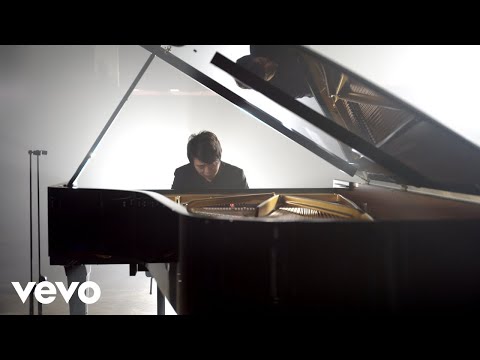
Bach
Goldberg Variations, Aria
Read
Narration sentence highlighting is idle.
A single singing line begins, already ornamented — a turn, a trill folded inside the descent rather than hung on it — and beneath it the harpsichord's bass answers in single, unhurried steps. That is the entire cast of the aria that opens the Goldbergs at first: one voice, one walking ground. Within seconds the motion settles into a slow tread, and the right hand is free above it to lean forward and hold back. Nearly everything that follows grows out of the relationship between those two jobs. The opening shape — rise, little cascade, settle — is the thing to keep in the ear.
The first minute teaches you how the piece breathes. Phrases lift and settle; an inner voice slips into the weave so the texture is briefly three-stranded, then thins again; and just past 0:50 the first full close arrives, the final notes left to decay until the room is nearly quiet — a real pause, hands off, before the music starts again beyond the minute mark. On this instrument loudness barely exists as a variable. Shape lives in timing, in the spacing between attacks, in how long a chord is allowed to ring, and the cadence is where you hear that work plainly.
What starts again climbs. The new phrase sits higher, the left hand steps upward in counterpoint instead of merely holding the floor, and a minor shadow soon crosses the harmony — the same warmth, cooler in color. Small hand-lifts act as commas between thoughts. This stretch is the most restless music on the page, more question than statement, the two lines trading attention while the tempo flexes with them.
Then, close to 2:00, the opening gesture returns — the same rise-and-settle, stated more tenderly, trills decorating the upper voice while the bass holds its slow floor. Nothing in the material has changed, and everything in the hearing has: after the minor passage the same shapes carry different weight, and the ear supplies the comparison on its own. That is the quiet trick of this form. The aria doesn't develop its theme so much as re-hear it, and it asks you to hold the first minute in mind long enough for the second hearing to differ.
From there the piece works in long waves. Phrase pairs lift and settle in the length it taught you early on; a gathering that starts around the three-minute mark — both hands busier, the line climbing again — lets its pressure out in a clear release near 3:19, and the stretch after sits lower and easier, as if a held breath had finally gone. Another build takes shape a minute on and resolves around 4:45 the same way, cadence by cadence, each one a small return of the habit learned at the first close. Nothing breaks the surface dramatically; the drama is distribution — where the weight sits, and when it gets set down. Through all of it the bass has kept moving in single steps, the least changed thing in the piece, the ground any memory of this music stands on.
After five minutes the tread loosens. Around 5:26 the regular step lets go of the ear, and the final phrase arrives not as continuous motion but as spaced, decaying events — single notes left alone in the room one after another — until the last tone rings out near 5:32 and the recording carries ten full seconds of silence behind it. It isn't a stop so much as a release into resonance, the instrument finishing the cadence on its own: one voice and the space around it, the whole cast the piece began with.
Last updated Aug 16, 2026 · Written with GLM 5.2 · Galdr 0.7.0.dev0 · Inner Ear Gemini 3.5 Flash Lite
Now playing
Goldberg Variations, Aria
Bach

galdr analysis
Click play to load galdr data.