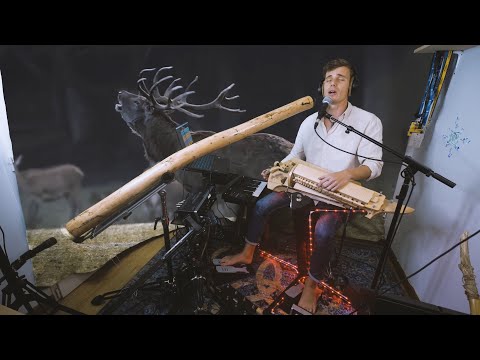
Eolya
Honneur
Read
Narration sentence highlighting is idle.
A low drone takes the room first—thin, continuous, more air and floor than melody. It does not announce itself so much as occupy the quiet, a dark sustained hum with almost no surface detail. The ear settles into its weight before anything else arrives.
A resonant male voice enters over that hum, chanted and centered, each phrase held long enough to fuse with the drone rather than ride above it. The tone is chest-warm, slightly grainy at the edges, rising and falling in measured arcs while the low pad stays almost motionless underneath. For a stretch the two surfaces simply coexist: voice as forward mass, drone as the suspended floor that keeps the body from floating free. Then the voice thins and trails off, leaving the pad alone again for a brief, emptied interval.
Around the one-minute mark the room thickens hard. Percussion lands in a firm, quick pulse and heavy synth-string layers push in with it, locking a motor grip that the earlier drone only suggested. The groove is not loose or swinging; it drives straight, martial in its regularity, drums and low-mid mass pinning the body while the string pads sweep and hold cinematic pressure across the midrange. Surface density jumps. What had been sparse harmonic warmth becomes a sustained wall of attack and tone, the pulse metronomic enough to seize motor attention even while a faint cross-current of accent lean keeps the grid from feeling entirely comfortable.
That pocket holds for a long stretch—drums cycling, strings pressing, the whole arrangement refusing to thin or break character. Pressure mostly sustains rather than builds or collapses; the body stays captured inside the same forward command. Small phrase lifts and drops move inside the texture, but the floor does not leave. Even when the energy seems to lean or re-enter after the midpoint, the same percussive motor and harmonic mass reassert themselves, keeping the listen braced and marching rather than released.
Near the close the density eases. Choir and chanting male voices return over a softer supporting backdrop, the hard rhythmic drive receding so the vocal mass can sit closer again. The pulse loosens its hold; attention and bodily grip fall away together. A final pattern break, then the sound empties—almost no residue left in the room once the last pressure releases.
Last updated Aug 15, 2026 · Written with Grok 4.5 · Galdr 0.7.0.dev0 · Inner Ear Gemini 3.5 Flash Lite
Now playing
Honneur
Eolya

galdr analysis
Click play to load galdr data.