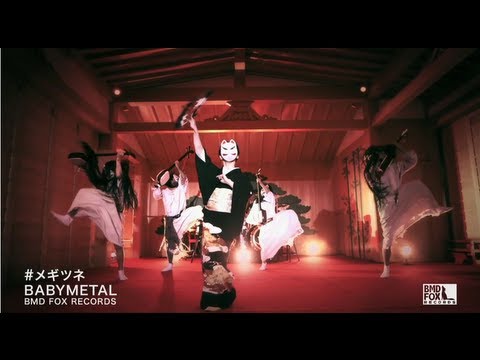
BABYMETAL
Megitsune
Read
Narration sentence highlighting is idle.
The first seconds are already in motion: distorted guitar in a tight chug, drums pushing a fast, squared-off metal pulse, the whole thing cut more like a command than an invitation. It is heavy, but not loose-heavy; the pressure is organized, clipped into a grid the body can grab immediately. Then the upper air changes. A Japanese festival-flute color threads in above the riff around 0:09, bright and nasal against the dark guitar mass, and the track suddenly has two bodies at once: ceremonial lift on top, machine drive underneath.
The chants that arrive after the opening stretch do not soften the surface. They land as percussive syllables, shouted in short groups, riding the beat rather than floating over it. The voices make the rhythm feel more crowded but also more communal, like the track has found a call-and-response shape inside the metal charge. Around 0:30 the lead voice starts flicking through quick, playful phrases while the backing voices answer in tight little bursts. The arrangement is thick, yet the pocket stays surprisingly usable: double-kick pressure, guitar grind, chant, and flute all keep snapping back to the same forward line.
When the clean lead vocal opens wider near the first big melodic lift, the sound does not abandon the motor. The voice stretches above it with a clear, centered tone, and that contrast is the thrill: a bright line held steady over drums that keep the floor moving fast. Around 1:12, the chorus space feels broader because the vocal note lengthens and the guitars stop behaving only like bite; they become part of a larger wall. The heaviness gathers underneath the melody rather than swallowing it. Her tone stays clean, almost polished, which makes the surrounding metal texture feel rougher by comparison.
The middle break pulls the ear sideways without letting the pulse disappear. The flute returns as a lead color over a more exposed pounding pattern, and for a moment the track’s surface feels less like a wall and more like a festival procession being chased by metal drums. The body still knows where to step. Then, around 1:53, the guitars and drums reassert the thickened metal frame, not as a total surprise so much as a re-clamping: cymbals flash, low chugs return, and the grid tightens around the listener again.
Past the two-minute mark, the chant writing becomes a physical feature more than a lyrical one. The repeated shouts around 2:20 strike in rapid blocks, almost like hand-drumming made of voices, while the low chugs and clipped drum attacks leave each vocal hit sounding hard-edged and dry. The guitar solo section cuts a hotter line through that established motion, its upper-register runs adding flame to a track that otherwise loves locked repetition. Even there, the solo is not an escape from the pocket; it rides the same fast machinery, bright metal filigree over the engine.
The final stretch stacks the familiar materials higher: clean vocal lift, backing shouts, distorted rhythm, cymbal spray, that relentless forward beat. Around 3:43 the weight gathers again under the moving pulse, and the last vocal extension presses upward while wide guitar distortion and cymbal impact spread the final hit outward beneath it. The ending does not slowly dissolve. After the final hit around 4:08, the grip breaks quickly; the body-lock is gone, the pressure empties, and the space that had been packed with motion is suddenly just absence.
Last updated Aug 18, 2026 · Written with GPT-5.5 · Galdr 0.7.0.dev0 · Inner Ear Gemini 3.5 Flash Lite
Now playing
Megitsune
BABYMETAL

galdr analysis
Click play to load galdr data.