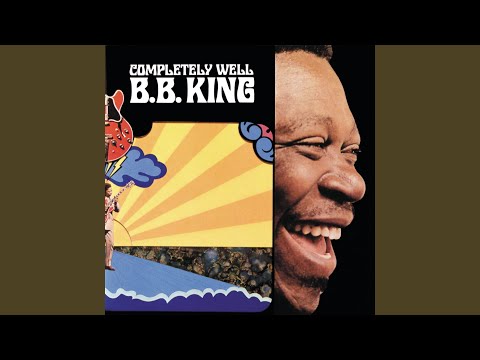
B.B. King
The Thrill Is Gone
Read
Narration sentence highlighting is idle.
A slow minor groove opens out of horns and strings already in motion — not a cold start but a room already breathing. The rhythm section settles into a moderate pulse that pulls the body in almost immediately, a motor capture that arrives within the first few seconds. The feel is suspended rather than heavy: the tempo moves forward, but the weight sits held and dragged underneath it, like walking through something thick. Staccato string accents punctuate the groove with short, clean strokes that cut against the sustained horn warmth, and the surface balance leans tonal and warm. Then the guitar enters — a bent high note that cries out over the band, sustained long enough to change the room's color before the voice arrives.
B.B. King's vocal enters around 0:34 with a rich, chest-forward tone — medium intensity, no strain, no push past what the moment needs. The band holds its pocket underneath him: rhythm section keeping the slow pulse, light strings sustaining pads behind. His voice carries the grain and weight of someone speaking from inside the situation, not performing it. When he finishes a phrase, the guitar answers — soaring bends that echo the vocal contour, as though the instrument is the second voice in the conversation. The guitar fills don't crowd the vocal space; they occupy the gaps the voice leaves, and the band never thickens beyond its medium density. Everything stays in proportion.
The first guitar solo passage builds gradually. Strings swell underneath the lead guitar around 1:17, adding orchestral warmth without raising the pressure — the density grows, but the pulse stays exactly where it was. The guitar climbs with sharper vibrato, then eases back into a rhythmic blues cadence, and the strings recede. The release is subtle: no drop, no rupture, just a gentle thinning of the texture as the band returns to its core rhythm-and-guitar conversation. The vocal re-enters with the same medium delivery, and the groove has not moved.
A more dramatic string swell arrives around 2:21 — orchestral strings rising in a sweeping gesture that briefly fills the upper register. It resolves back into the blues groove without breaking the pulse, and the lead guitar enters with a new solo phrase. This is where the guitar begins to climb higher, vibrato flourishing, the notes sharper and more insistent. The body capture stays strong — the pocket holds — but the surface above it becomes more active, more particulate. The guitar's attacks spread around the beat with a loose, elastic phrasing that never threatens the grid but keeps the ear aware of where the strikes land.
The final vocal turn begins around 2:10 and carries through the late release lines before the guitar outro around 3:10, with the guitar continuing to punctuate the spaces between phrases. The delivery remains soulful and controlled — no screaming, no strain, just the same rich chest tone carrying the words. As the track moves into its final stretch, the guitar leads into an outro solo with sustained notes that hang in the air. The band holds the groove underneath, the pulse steady, the motor capture still gripping the body until close to the end. Then around 5:20, the motion releases — the pattern breaks, the bodily hold loosens, and the sound thins toward silence. The last audible fact is the groove letting go, not a dramatic finish but a slow exhale, the room emptying on its own terms.
Last updated Aug 14, 2026 · Written with GLM 5.2 · Galdr 0.7.0.dev0 · Inner Ear Gemini 3.5 Flash Lite
Now playing
The Thrill Is Gone
B.B. King

galdr analysis
Click play to load galdr data.