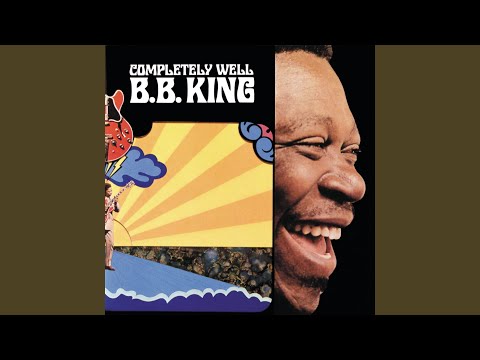
B.B. King
The Thrill Is Gone
Read
Narration sentence highlighting is idle.
The groove is already moving when the track opens — horns, guitar, and a rhythm section settling into a slow minor-key blues that doesn't need to announce itself. Within the first few seconds the pulse finds the body and stays there. This is a motor hold that never really lets go: the beat is steady, the pocket is deep, and the weight underneath is suspended rather than heavy. It drags just enough to feel like gravity. A lead guitar bends out around 0:11, crying over the band, and the horns answer in smooth cadence. The guitar sustains a long high note, and then at 0:34 the voice arrives — B.B. King, rich and unhurried, singing the thrill is gone as though he has already lived with the loss long enough to make it sound like fact.
The first verse moves from statement to accusation. The band holds its pocket while the voice carries the weight of the words, and when the vocal phrase ends the guitar steps in to answer — soaring bends that echo what the voice just said, as if the instrument is finishing the thought the singer couldn't. Strings swell underneath the guitar solo, adding orchestral warmth that lifts the surface without breaking the groove. The guitar builds with sharper vibrato, then eases back into the rhythmic cadence. When the voice returns around 1:34, it brings the second verse and a turn toward resignation: although I'll still live on / but so lonely I'll be. The music doesn't darken for that line. The groove keeps its shape, the strings keep their pads, and the restraint is the point — the sorrow is carried by the pulse, not dramatized over it.
The third verse arrives around 2:10, and the lyric shifts. It's gone away for good — the phrasing hardens from loss into acceptance. Then comes the turn that changes the song's emotional direction: you know I'm free, free now, baby / I'm free from your spell. Around 2:21 the strings rise in a sweeping orchestral swell that feels like the track's largest single gesture of color. It resolves back into the blues groove, while the voice delivers release with the same medium, soulful intensity it has carried throughout — no shout, no break, just a man stating his freedom as plainly as he once stated his grief. The final lyric lands as a graceful farewell: and now that it's all over / all I can do is wish you well. The guitar fills punctuate the spaces between phrases, and then the voice steps away for the last time.
What follows is a long outro solo — the guitar leading with sustained notes, bending and singing over the groove that has been there since the first second. The band holds its pocket while the guitar works through the remaining feeling, and the pressure stays sustained until around 5:10, when it finally begins to release. The pattern loosens, the motor hold recedes, and by 5:22 the sound gives way to silence. The groove doesn't crash or collapse. It simply lets go, and what's left is the space where the pulse used to be.
Last updated Aug 14, 2026 · Written with GLM 5.2 · Galdr 0.7.0.dev0 · Inner Ear Gemini 3.5 Flash Lite
Now playing
The Thrill Is Gone
B.B. King

galdr analysis
Click play to load galdr data.