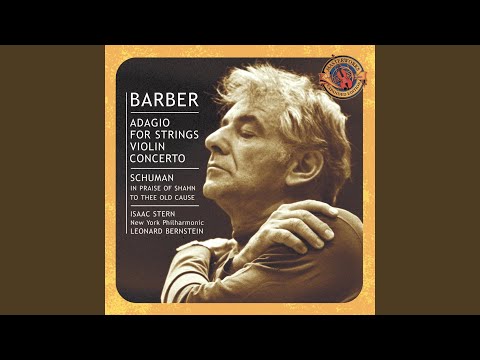
Samuel Barber
Adagio for Strings
Read
Narration sentence highlighting is idle.
The piece begins with the size of its quiet. One violin line, soft enough that the first note feels like it was already in the room before the recording started, and then the small event everything else grows from: the melody steps upward, leans, settles. No bass under it, no rhythm, nothing but that single drawn bow. Whatever associations you bring — funerals, films, its strange public life as America's music for grief — the actual sound starts here, at the bottom of a staircase it means to climb one step at a time.
The mechanism reveals itself patiently. The theme comes back, but each return begins a step higher and passes through a darker part of the orchestra, so the same line keeps arriving warmer and heavier than before. The swells behave like breathing: a phrase gathers, crests, resolves downward, and the hush after each crest carries as much expression as the crest itself. Around 2:50 the lower strings finally hold a real floor beneath the melody, and the texture has thickened from that lone voice into something woven. There is no regular beat to tap, no grid that becomes the listener's main handle, so the body couples to the bows instead, inhaling with each swell and settling as it falls back. This is breath-time, not clock-time.
A first fuller arrival comes around 3:57, and because it was earned so slowly, the ensemble crest feels physical rather than dramatic. Then comes the gesture this piece does better than nearly anything in the repertoire: it lets go. By 4:54–4:58 the sound pulls back sharply toward the quiet it came from, and the opening's bareness returns changed — no longer innocence but aftermath. We've seen the top of the staircase now, and the music begins the climb again with that knowledge sitting in the room.
The second ascent takes nearly two minutes and moves in taller waves, each swell launching from a higher shelf, each release leaving more behind. At 7:00 comes the longest silence of the whole recording: close to five seconds of almost nothing, exactly where the ear is leaning hardest for the next phrase. It is the hinge of the entire arch. Everything on the far side of that held breath is rise.
The final climb surges in stages — gathering, cresting, gathering again past 8:17, but now as a narrower last push rather than the great central pressure point. Just past nine minutes the line reaches its final crest, sustained briefly by the section, and around 9:04 it breaks off. Not a taper — a cut. The chord simply stops, and the silence it leaves behind hits with more force than the sound did.
What follows is the passage no movie ever uses: the music returns at a whisper, in pieces. Short fragments of the opening theme, each separated from the next by a rest, as though the melody has to breathe between phrases. Each fragment sits lower and softer than the last, the staircase descending in the dark until one final low chord is all that's left, decaying for seconds before the room goes fully silent at the end. It finishes where it began — one quiet sonority in a large space — except that now the silence weighs something, and the recording is generous enough to let you sit inside that weight until it, too, is gone.
Last updated Aug 17, 2026 · Written with GLM 5.2 · Galdr 0.7.0.dev0 · Inner Ear Gemini 3.5 Flash Lite
Now playing
Adagio for Strings
Samuel Barber

galdr analysis
Click play to load galdr data.