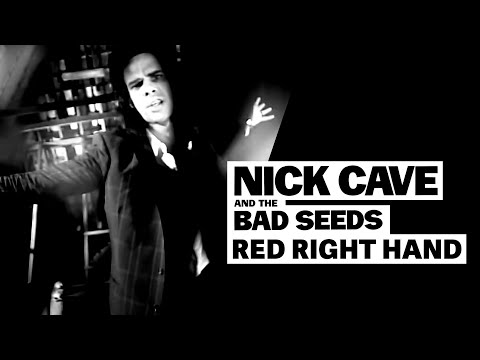
Nick Cave & The Bad Seeds
Red Right Hand
Read
Narration sentence highlighting is idle.
Bell notes and a bass figure are the first things out of the dark, and the pulse is complete almost before you've settled — a low, loping line with bright metal strikes landing just off it, organ shadowing from underneath. Nothing is announced. That's the arrangement's whole wager, made in the first three seconds: this groove is going to walk at exactly this pace for nearly five minutes, and every ounce of dread will come from its refusal to hurry. Nick Cave arrives around 0:12, low and half-spoken, sending you on a walk past the edge of town, and he leans his phrases against the beat the way the bells do — behind it, around it, never square on it.
The verse runs long with no chorus waiting to receive it. Underneath, the organ swells a little thicker each phrase while the percussion stays muted, and the rhythm has your body without ever offering it a seat — you march to this, you don't relax into it. Just before the minute mark the voice steps out and nothing collapses with it: the bass keeps its figure, the organ holds its chords. First quiet proof that the motion belongs to the groove, not the singing.
When the man himself arrives — arms around you, told you've been a good boy, dreams rekindled that took a lifetime to destroy — the music neither brightens nor darkens for him. The litany gets chanted flat across the same stretch of bars: he's a god, he's a man, he's a ghost, he's a guru. The words swell with power; the organ withholds everything. That gap is the song's engine — the vocal can promise or threaten anything, and the tempo will not move one inch for it.
The second verse sharpens the delivery into direct address — no money, no car, no self-respect, feeling like an insect, and don't worry, buddy, because here he comes — until the voice names the stacks of green paper and then, at 2:33, simply leaves. What follows is the longest unbroken stretch of the recording: the organ moves to the foreground and thickens layer by layer, the percussion busies itself, and the same pulse keeps walking beneath all of it. It gathers without erupting, which turns out to be scarier — he is on his way whether anyone is singing or not.
The final verse lands around 3:47 over the fullest surface the song has shown, and the pictures come fast: nightmares, dreams, the TV screen, and a voice wanting you to turn it off. The litany returns with its order flipped — he's a ghost, he's a god — the same words reshuffled over a groove still identical to bar one. Then the plainest threat in the lyric, one microscopic cog in his catastrophic plan, and for once words and music agree completely: the fixed, patient grid was the plan all along.
Around 4:32 the grip finally loosens. The motor recedes, the surface frays in small breaks, organ chords land farther apart, and a low rumble thins until, seconds later, there's nothing left. The hand never strikes. It just stops being audible.
Last updated Aug 16, 2026 · Written with GLM 5.2 · Galdr 0.7.0.dev0 · Inner Ear Gemini 3.5 Flash Lite
Now playing
Red Right Hand
Nick Cave & The Bad Seeds

galdr analysis
Click play to load galdr data.