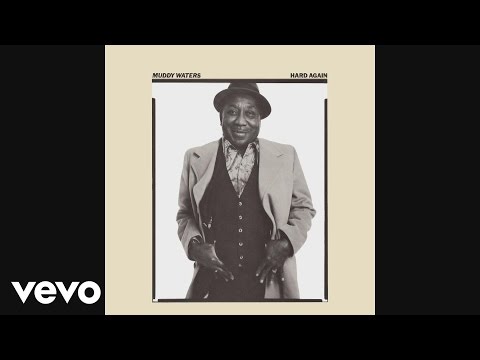
Muddy Waters
Mannish Boy
Read
Narration sentence highlighting is idle.
Two silent seconds, and then the voice arrives already at full size — no run-in, no warm-up, Muddy Waters shouting from the first syllable with the beat already rolling under him. A few bars in comes the first taste of the trick: a beat where nearly everything falls away, and his voice keeps standing in the open space. The opening line is closer to a benediction than a lyric — everything's gonna be alright this morning — promised flat-out over the groove. By 0:21 the whole shape of the record is on the table, and the point is that nothing new is coming. Everything after this is deepening.
One chord, and it never changes. The figure is a strike and a quit — the band hits, leaves a hole, hits again — and all the drama lives in the hole. Waters breathes in the same pattern as the riff: every line starts at the top of his push and settles back as the answer lands, sometimes a bright guitar flash, sometimes a whoop from the room. It's slow, but it bounces more than it grinds, and the attacks lean around the beat rather than on it — a riff that sits back without ever arriving late. The groove takes the body but keeps it leaning forward; there's no sinking into this one.
The first verse is a mother's prophecy — five years old, told he'd be the greatest man alive — and after the man past twenty-one comes the spelling: I spell M, A, child, N, one letter per hole, the band punctuating between them, the room shouting back at every landing. The alphabet is the whole argument — and then he flips it, adds the B, the O, the Y, and wears the word as a title. The roll call that follows stacks his own legend — full grown man, natural-born lover's man, a rolling stone, the hoochie coochie man — his own songbook recited as credentials. The second verse runs the moon two hours late and the spelling comes around again with the room audibly louder.
The boasting carries through the back half, and just past 3:02 the phrase lifts into the long final run. Midway through it the vocal steps out entirely and the band stretches across the holes, a lead line moving through the same unchanged shape. Then, late, something small: a plea to hurry, and twice, don't hurt me, child — the only crack in all that armor, and the music resists it completely. Same chord, same gaps, same strikes. The begging doesn't slow the machine by a hair; it just sits on top of it, human-sized.
One last gather of weight around 5:09, a couple of easy yeahs as the band eases beneath him, and then the figure comes apart — one stab, then another, each landing more alone than the last. When the final hit cuts off at 5:23, Muddy laughs: that does it. Five and a half minutes of spell, and it ends in a chuckle, with the room rushing in to answer him.
Last updated Aug 16, 2026 · Written with GLM 5.2 · Galdr 0.7.0.dev0 · Inner Ear Gemini 3.5 Flash Lite
Now playing
Mannish Boy
Muddy Waters

galdr analysis
Click play to load galdr data.