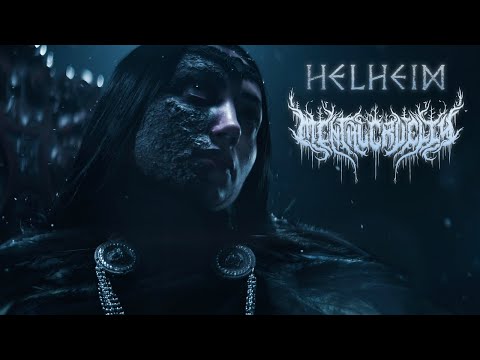
Mental Cruelty
Helheim
Read
Narration sentence highlighting is idle.
The first second is withheld, just enough black space to make the entrance feel staged. A low orchestral mass rises out of it, brass-colored and ceremonial, and then around 0:09 the recording tears open: blast beats, distorted guitars, and choral synth arrive together in a bright, violent sheet. The body gets the grid immediately, not as swing or looseness but as command. When the vocals enter, the low guttural and higher shriek make the lyric’s mythic self-naming feel less like exposition than possession: I am daughter of Loki comes through as an occupied throne, not a character introduction.
The early rush keeps changing its footing without losing the pocket. Fast double-kick passages and tremolo pressure give way near 0:31 to a heavier half-time drive, where the drums stop feeling like weather and start feeling like machinery. The vocal trades have more room to bite there; the growls sit in the chugs, while the shrieks scrape across the top of the symphonic layer. When Hel, goddess of the rotten lands, the arrangement has widened into something almost processional: choir and horns behind the punishment, drums steady enough to make the line feel carved into stone.
That steadiness is the song’s real cruelty. Even when the surface is frantic, the form keeps presenting usable floors: blast, stomp, slam, return. Around 1:09 the low chugs and huge kick hits pull the track into a breakdown that feels less like a pause than a sentence being hammered one word at a time. The repeated banishment from Valhalla matters because the riff makes exclusion physical; the bottom end does not merely decorate the threat, it gives the threat a place to stand. Then the speed comes back, and the chorus material returns larger because the breakdown has taught the ear how much gravity is under it.
The clean break after 2:09 is the one real opening in the wall. Acoustic guitar arpeggios and soft strings don’t cleanse the track; they make the cold visible. With the drums and distortion withdrawn, the harmony has a bleak, suspended color, and the martial pulse is replaced by waiting. Timpani and brass begin to gather under that fragile surface, so when the heavy drop arrives around 2:34 it doesn’t feel random. The guttural vocal comes back as if pulled up from underneath the acoustic passage, and the riff lands slower, thicker, more dungeon than battlefield.
The guitar solo that follows cuts a different kind of path through the same underworld. Its neoclassical runs and harmonized lines bring a sharp, almost luminous contour into music that has mostly moved by pressure and impact. The drums keep racing beneath it, orchestration swelling around it, but the lead guitar gives the track a blade-edge clarity before the vocal mass returns. In the last stretch, the imagery of the divided body — Half of me living, and half is decayed — finally matches the arrangement’s own split nature: symphonic grandeur above, deathcore machinery below, both locked to the same forward drag.
By the time Helheim is called near the end, the song has turned repetition into territory. The shore, the throne, the rotten bodies, the frozen stairs: they have all been made audible through returns that come back with more weight on them. Then the hold releases. Around 3:49 the track falls into silence long enough to feel like a rupture rather than a tidy fade, with only the last trace of room and pressure hanging at the edge before the recording is gone.
Last updated Aug 26, 2026 · Written with GPT-5.5 · Galdr 0.7.0 · Inner Ear gemini-3.7-flash
Now playing
Helheim
Mental Cruelty

galdr analysis
Click play to load galdr data.