Marvin Gaye
What’s Going On
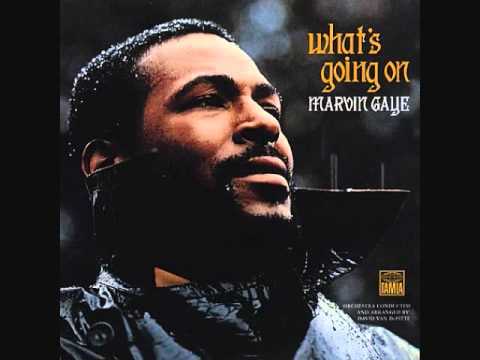 Listen on YouTube
Before the plea arrives, there is a room already in motion. Voices cross each other with the loose confidence of people greeting, teasing, warming the air: "Hey, brother, what's happenin'?" and "Boy, this is a groovy party." The track does not ask for silence before it begins. It lets social noise become the threshold. The first thing I feel is not a downbeat but an invitation to enter a moving crowd, where the question in the title is casual enough to be said at a party and large enough to carry the whole song.
Then the pulse settles under the talk, light on its feet but steady enough to take over the body. The drums do not stomp; they keep time with a relaxed insistence, and the low line gives the motion a rounded floor. Everything leans forward without sounding forced. The groove has a settled pocket: bass, percussion, and backbeat make a center that keeps catching the voice when it floats away from strict time. There is no big shove into the first verse. The arrangement slides from gathering to song as if the room has decided, together, to listen.
When the lead voice enters with "Mother, mother / There's too many of you crying," the air changes. The party frame stays audible in the softness of the track, but the words put a wound inside it. Gaye’s voice does not attack the line; it opens it. He sings as if the sentence has to remain human while it names what cannot be softened: crying, dying, escalation, war. The music keeps its warm motion beneath him, and that steadiness prevents the lyric from becoming a speech. The plea rides the groove, so the question is carried by movement rather than pinned to a podium.
The first turn into "You know we've got to find a way / To bring some loving here today" feels less like a lift than a widening. The harmony moves with a gentle restlessness, changing color while the pulse keeps its even walk. Background voices answer and cushion the lead, not as decoration but as people in the same room catching the same sentence. When "Father, father" arrives, the address expands. The track keeps naming relations—mother, brother, father—until the social space of the intro becomes a family space, then a civic one, then something closer to a shared moral temperature.
The refrain does not explode. "What's going on" returns as a question that knows it will have to be asked more than once. The answering voices make it circular, and the repetition does a quiet kind of work: each pass makes the question less private. Around "Picket lines and picket signs," the rhythm stays supple, but the lyric tightens the frame. "Don't punish me with brutality" lands plainly, without theatrical force, and that plainness cuts through the sweetness around it. The track keeps its polish, its flow, its elegance, yet there is a hard edge in the words that the arrangement refuses to bury.
After the refrain, the voice loosens into syllables and cries—“Ah-ah-ah-ah,” “woo,” “ba-da-boo-doo”—and the song becomes less verbal without becoming empty. This middle stretch is where attention changes most for me. The words have already named the trouble, so the nonverbal singing feels like the body processing what the sentences opened. The groove keeps moving, light but captured, while the surface fills with small vocal turns and responses of "Right on, baby." It is communal without becoming crowded. The track lets affirmation sit beside grief, as if the only way through the pressure is to keep the pulse alive.
The second verse brings judgment into the room: _"Everybody thinks we're wrong / Oh, but who are they to judge us / Simply
Listening Signal

Galdr analysis
Click play to load Galdr data.
Now playing
What’s Going On
Marvin Gaye
Click play to load Galdr data.
Music signal
Harmony + melody
Galdr concepts
Derived motion