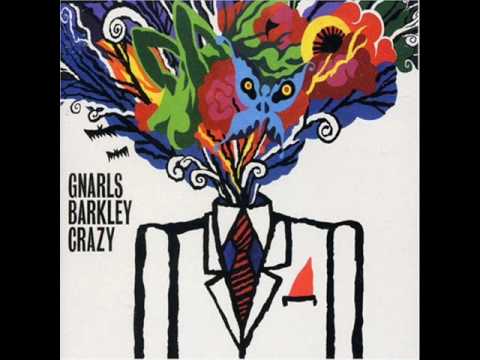
Gnarls Barkley
Crazy
Read
Narration sentence highlighting is idle.
There's barely a doorway. A breath of room, then the track is already loping — a light, quick step down low and strings pulling a fraction behind it, so the whole thing sways before it walks. CeeLo arrives four seconds in, mid-confession, warm as a man settling into a good chair: I remember when I lost my mind. He sings it like a fond memory, and that's the whole trick of the song in one line — disaster remembered as pleasure.
The step underneath never wavers, but nothing sits squarely on it. The strings trail the beat, the low end is warm mass more than punch, and so the body gets taken — head nodding on the two — while a slight drag keeps everything tilted, held rather than driving. It's a suspended kind of groove: you're in it, not on it. And this floor never changes shape. For nearly three minutes, everything that happens happens inside it.
Around 0:36 the first chorus isn't the arrangement breaking open so much as the voice deciding to use all of itself. He climbs into Does that make me crazy? with the strings swelling up to meet him, asks three times until it stops being a question and becomes a chant, then answers himself with one small word and a shrug. The music never argues. It has been agreeing with him since the first verse, and it agrees now.
The next verse plays advisor — hope you're having the time of your life, but think twice — and then, near 1:13, the song's best piece of theater: the voice drops its intimacy and turns on somebody. Who do you think you are, he taunts, half-spoken, and then he actually laughs at them — bless your soul — before landing the verdict that they only think they're in control. It's the first moment he steps outside the confession to grin at someone else, and the comedy works because nothing under him flinches: the strings keep their courtly calm while he cackles. The accusation boomerangs anyway — the chorus that follows calls them crazy, just like him, pointed outward and inward at once.
After that, the stakes quietly change. The third verse is testimony about heroes who had the heart to risk their lives on a limb, about how it looked like fun ever since he was little, and at 2:15 the bravado pays its bill: I can die when I'm done. He doesn't underline it. The line rides the gather almost casually while drums and strings build beneath it, and that plainness is what stings — the pleasant place from the opening now has a price on it.
The last chorus widens the circle — maybe I'm crazy, maybe you're crazy, maybe we're crazy — each maybe pulling another person in, until the whole thing lands on the smallest, most disarming word in the song: Probably. Not a verdict, not a plea — a shrug with the lights up. He lingers after it, ad-libbing softly as the loop begins its descent, and at 2:54 the floor finally eases away: the pulse lets go of the body, the strings release their held color, and the tail rings out into the room until there's nothing left to sway with.
Last updated Aug 22, 2026 · Written with GLM 5.2 · Galdr 0.7.0.dev0 · Inner Ear Gemini 3.5 Flash Lite
Now playing
Crazy
Gnarls Barkley

galdr analysis
Click play to load galdr data.