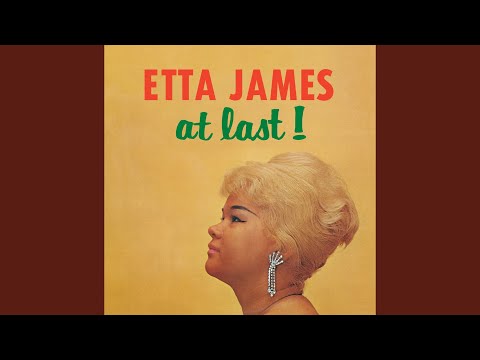
Etta James
At Last
Read
Narration sentence highlighting is idle.
Strings arrive first — not a melody yet, but a warm harmonic mass, a sustained tonal floor that fills the room before anything moves. The surface is almost entirely harmonic: no percussive edge, no attack to latch onto, just bowed tone settling into place like a curtain being drawn. Around five seconds in, a low pressure begins to build underneath, a subtle swell that thickens the strings without breaking their hold. The body has almost nothing to grip here. There is a pulse somewhere in the arrangement, faint and metronomic, but it stays beneath the surface, offered but not seized. For nearly twenty seconds the track exists in this suspended state — weighted, slow, draped in string warmth, with no rhythm section asserting itself and no voice yet to focus the ear.
Then the voice enters at 0:19, and the whole frame tightens. Etta James arrives not with attack but with placement — the word at last lands low and full, chest-weighted, sitting inside the string bed rather than cutting across it. The tone is dark and grainy, a voice with texture you can feel against the smooth orchestral surface around it. What changes immediately is the attention: the motion that had been drifting now has a center. The strings thin slightly to make room, and the vocal carries the harmonic weight almost alone for a few bars. When the phrase lifts at 0:28 — my love has come along — the strings follow it upward, a gentle swell that mirrors the vocal contour without competing. The rhythm section is still essentially absent. Whatever pulse exists is carried by the voice's own phrasing, the way each line leans forward and settles back, a breath-shaped meter rather than a groove.
The first real shift in the supporting floor comes around 0:56, after the vocal pushes harder on oh yeah, yeah and the band quietly locks in behind her. A rhythm section enters — not a crash or a full-band arrival but a gentle, slow-tempo groove that finally gives the body something to sit on. The motor capture that had been hovering now takes hold. Drums, bass, and piano settle into a pocket that is comfortable and unhurried, and the strings continue to drape over the top. From here through the next two minutes, the track lives in a held state: pattern intact, attention locked, the groove steady and warm underneath while the voice moves freely above it. The phrase lifts and drops in long arcs — rising at 1:00, settling at 1:04, rising again at 1:09 — and each time the strings swell and recede with the vocal line, breathing together.
Through 1:00–1:12, the voice is still in the foreground, carrying the second stanza over the newly seated rhythm section. After the stanza resolves, a brief string-forward turn bridges the space before the next vocal entry, but the voice is back by around 1:27 on I found a dream. It returns into a thicker arrangement than the opening had offered, and the contrast is felt in the chest: more band pressure, more mid-range warmth, the groove now fully seated. The violins remain active around the line, carrying bright answering motion over the rhythm section, and the floor feels different from the opening — less suspended, more grounded, the bass and piano giving it a body the strings alone never had.
The ornamental flashes at 1:17 and 1:44 — bright local flickers inside the phrase, likely string figures or a piano filigree — catch the ear because everything around them is so smooth and sustained. They are small interruptions in an otherwise fused surface, tiny sparks of detail against the warm wall. The vocal grows more resonant through the bridge, pressing lower and harder on I found a thrill to press my cheek to at 1:42, and the band responds by thickening underneath without surging forward. The pressure builds in the low-mids, the body band carrying more weight, but the groove never accelerates. It stays in its slow pocket, letting the voice do the pushing.
The climax arrives around 2:14–2:28, and it is earned by everything the track withheld earlier. The full orchestral weight gathers behind the vocal as she moves through and here we are in Heaven, and the final at last at 2:28 is a soaring belt that opens the upper register wide. The strings are at their thickest, the rhythm section at its most committed, and the voice rides above all of it with a force that the first minute never hinted at. Then, quickly, the hold loosens. Around 2:49 the motor capture recedes — the groove lets go of the body — and the attention that had been locked for nearly two minutes begins to release. The strings sustain a final chord and decay into warm reverberant space, the rhythm section drops away, and the track empties into room tone. What is left is the resonance of the room itself, the last audible fact before silence.
Last updated Aug 15, 2026 · Written with GLM 5.2 · Galdr 0.7.0.dev0 · Inner Ear Gemini 3.5 Flash Lite
Now playing
At Last
Etta James

galdr analysis
Click play to load galdr data.