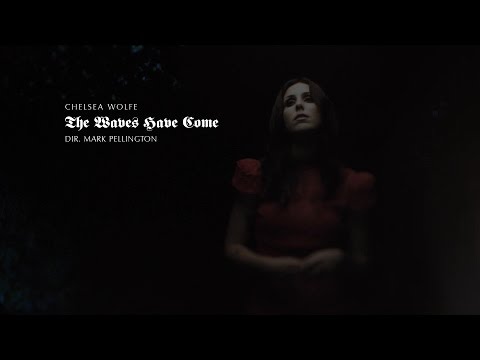
Chelsea Wolfe
The Waves Have Come
Read
Narration sentence highlighting is idle.
A few seconds of air sit before the first real hold, then the music comes in with a slow, repeated figure that gives the track its whole method: steady time, dark resonance, very little hurry. The pulse is there, but it does not grab like a beat made for movement. It feels counted out by weight. Each chord returns to the same kind of place, and the space around it stays wide enough for the sound to hang after it is struck.
When the voice enters near 0:26, "The pain forms a circle" does not arrive as confession so much as placement. The line is set inside the room the opening has already built. The singing is close and veiled, with a controlled ache at the edge of the tone, and the piano keeps the circle moving under it. "With a light at the center" gives the first image a cruel steadiness: the arrangement does not brighten in any simple way, but the attention narrows toward that center. I hear the song teaching me to wait on the next chord.
By the time she sings "I can see it from here, the end is coming," the track has settled into a procession. Nothing rushes toward that end. The line about waiting being "for nothing" lands over music that has made waiting physical, one return after another. The pattern is almost too reliable, which makes the words feel trapped inside it. The voice rises without breaking the frame, and the frame does not comfort her.
The images become stranger around 1:08: "I covered you in royal jelly / I made you queen and you forgave me." The arrangement keeps its slow body beneath that intimacy, and the sung melody starts to feel like it is circling a private ruin. There is warmth in the low-middle of the sound, a dark cushion under the voice, but it is not soft enough to erase the dread. When "We'll be given the world in the right time" turns into "But we made our own and left it empty," the track does not pivot dramatically. It lets the emptiness appear inside the same repeated motion.
The first refrain near 1:52 tightens the song’s grammar. "This will be ours" is sung like a claim made against evidence. The following phrases — "we're the concept," "we're the flawed," "we're the answer" — stack identity into the pulse, each one returning to the same slow machinery. I feel the song becoming more vertical here, less like a path forward than a column being built upward from grief. The accompaniment holds its shape; the voice has to carry the change.
Around 2:22, the quoted speech opens another chamber: "It won't be long now / You'll leave the world and you will join me here." The music is still steady, but the distance inside it changes. The line sounds like a promise and a summons at once, and the voice gives it enough tenderness to make it more frightening. "My flesh is afraid but I am not" brings the body into the song as something separate from will, separate from devotion. The piano keeps marking time as if the body has no veto.
Then the loss becomes sensory. "They took your smell, they took your shadow" is one of the places where the arrangement feels most bare even though it has not emptied. The repetition underneath turns searching into compulsion. "I'm searching through faces for someone familiar" moves across that same slow grid, and the voice seems to look outward while the harmony keeps pulling inward. When she sings "I clawed and I clawed, but I couldn't find you there," the phrasing roughens the surface without needing the band to explode. The track stays patient, which makes the line worse.
The refrain returns near 3:42, but now it has gathered more mass. "This will be ours" no longer sounds like the first claim; it has memory behind it. The phrases expand: "we're the stars," "It won't be long, now," "It will be ours." The repetition is not decorative. It becomes a ritual of insistence, a way of forcing a future to appear by naming it again. Around 4:21, when "we're the cause" enters the chain, the song’s steady pulse starts to feel less like accompaniment and more like a verdict being repeated in slow motion.
After 5:00, the language changes shape again. "Creation was the only word" lifts the song out of the personal address and into something larger, but the music does not open into relief. It keeps the same suspended weight, and the voice has to widen inside it. The lines about not needing "physical things" to feel and dream arrive over a track that has made physical things unavoidable: pulse, resonance, held breath, the drag of each return. The contradiction is audible. The song wants beyond the body, but it keeps moving through one.
The late section beginning around 5:38 is where the scale finally cracks open in the words: "When earth cracks open and swallows." The arrangement has been preparing for catastrophe without announcing it. Now the image matches the size of the hold. "Then we'll never be tired again" and "we'll be given everything" are sung into the same slow ground, but exhaustion is all over the duration by now. The promise of release sounds like it has been worn smooth from saying it.
"The moment we realize we're not in control" pulls the song into its final argument before the tide fully names itself. Then the repeated "Never to return to me" arrives, and the voice keeps giving the phrase back to the music. It is plain, almost unbearably plain after the mythic language before it. The song has moved through pain, queenship, worlds, stars, creation, earth opening; the final human fact is absence. The repetition does not deepen the thought by explaining it. It deepens it by refusing to move on.
Past 7:12, the pattern begins to loosen. The pulse that had carried the whole track starts to lose its hold, and the sound drains rather than collapses. There is no grand release, no last impact big enough to pay for what has been accumulated. By about 7:28, the music has fallen away into silence, and the remaining seconds are not a new section. They are the space left after the last return fails to bring anyone back.
I come out of this track with the sense of having been kept in one long, slow current. Its force is not in sudden change, but in the refusal to let the repeated figure stop meaning something. The lyrics keep enlarging grief until sea, earth, body, and creation all become part of the same loss, while the arrangement holds to its grave pace. When the silence arrives, it feels like the only ending the song has allowed itself: the waves have done their work, and the room is empty.
Last updated Jul 21, 2026
Now playing
The Waves Have Come
Chelsea Wolfe

galdr analysis
Click play to load galdr data.