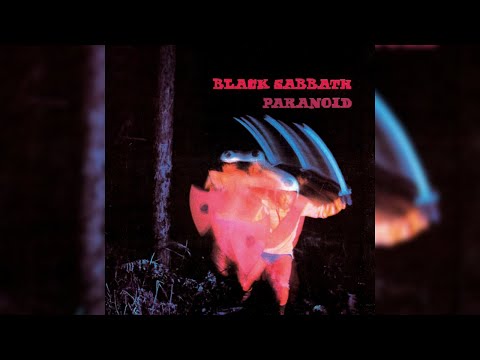
Black Sabbath
Paranoid
Read
Narration sentence highlighting is idle.
The guitar riff arrives like a machine already at full speed — no intro, no warm-up, no handshake. From the first second the distorted chord sequence is already cycling, and the band locks in behind it with a fast, flat-out pulse that never really relents. What's striking is how quickly the body gets seized: within a couple of seconds the rhythm has you, not because it's heavy in a dragging sense but because it's relentless. The weight here is motor weight, not gravitational drag. The riff repeats, the drums pound underneath, and the whole surface stays at one sustained pressure level — the room isn't filling or emptying, it's just already full and staying there.
Ozzy's voice enters around 0:12 over the top of this driving chassis, and the first thing you notice is how small and clean it sounds against the wall of distorted guitar underneath. He's not pushing or screaming — he's singing in a clear, almost conversational register while the band churns beneath him. The lyric opens with a blunt breakup line and moves quickly into something more unsettled: people think I'm insane because I am frowning all the time. The words describe a mind unraveling, but the music doesn't mirror that descent. It stays level, mechanical, forward-charging. There's a gap between the vocal distress and the band's steady stride, and that gap is where the song's tension actually lives.
A brief instrumental break lets the riff breathe on its own, then the voice returns for the second verse. The same pattern holds — Ozzy carrying the narrative while the rhythm section maintains its locked, driving pulse. When the lyric reaches the plea — can you help me, occupy my brain — the vocal stretches upward with a slight edge, the first moment where the voice pushes against its own register. It's not a scream, but it's the first crack in the composure, and it earns the guitar solo that follows.
The solo launches at 0:56 and briefly becomes the track's central event. The guitar takes over the foreground with fast, screaming runs while the rhythm section underneath doesn't shift at all — same tempo, same pattern, same pressure. The solo doesn't build toward anything so much as occupy the space the vocal left, filling it with high-pitched distorted lines that climb and circle. The band's refusal to change underneath the solo is its own kind of statement: no dynamic rise, no breakdown, no letup. The pocket holds firm through the solo section, and when it winds down, the voice returns around 1:14 as if the machine has simply carried on underneath it.
That return begins the next verse, and the structure repeats its own logic while the lyrics keep darkening. The delivery stays controlled, almost matter-of-fact, which makes the words land harder than any wail would. After that verse, the band moves into a longer instrumental stretch, letting the riff and lead guitar occupy the foreground again without loosening the pulse. Around 2:00 the last verse arrives — Happiness I cannot feel, and love to me is so unreal — and the final section tightens further: I tell you to enjoy life, I wish I could, but it's too late. The band never softens for any of this. The riff keeps cycling, the drums keep driving, and the voice keeps its place inside the machine.
Then, at 2:44, the whole thing stops. A sudden cutoff — no decrescendo, no final flourish, no ritard. The pattern breaks, the motor hold releases, and the sound simply ends mid-charge. It's the most honest moment in the track: a song about a mind that won't stop racing, cut off mid-race, as if the only way to stop the machine was to pull the plug.
Last updated Aug 14, 2026 · Written with GLM 5.2 · Galdr 0.7.0.dev0 · Inner Ear Gemini 3.5 Flash Lite
Now playing
Paranoid
Black Sabbath

galdr analysis
Click play to load galdr data.