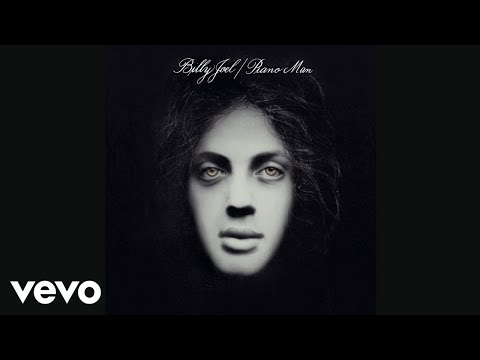
Billy Joel
Piano Man
Read
Narration sentence highlighting is idle.
The piano opens alone, rolling its chords instead of striking them, already swaying — the whole bar is in that lilt before a single word is said. At 0:06 the harmonica slips in with the song’s central hook, and the contract is set: piano, harmonica, a moderate pulse that leans rather than marches. Nothing here lands dead straight. The chords roll, the phrasing sits back against the beat, and that slight looseness is the feel — a Saturday stretching out.
The voice arrives low and conversational at 0:31, telling us about nine o'clock and the regular crowd shuffling in, and it barely lifts for four bars at a time. Then the first small turn: the old man asks for a song he half-remembers — play me a memory, sad and sweet, from when he wore a younger man's clothes — and Joel answers him with nonsense syllables, la-la-di-dee-da, humming the tune the man can't recall. The tune, of course, is this one. When the chorus finally comes at 1:27, a bass line and a soft drum pulse have come up beneath the la-las, and the title phrase lands like the request of the whole room at once, not just one lonely drinker.
From there the record breathes in tides. Each new portrait strips back toward piano and voice; each chorus refills the space with the band. John at the bar, quick with a joke and dying to be somewhere else — around 2:11 the low end thickens just as the confessions get plainer, the vocal pressing harder on I believe this is killing me. Paul the real estate novelist, Davy still in the navy, the waitress practicing politics on slowly stoned businessmen, and then the hinge of the whole middle: a drink they call loneliness, but better than drinking alone. The singalong la-las drift through between stories like the crowd joining in without being asked.
The second chorus, near 3:42, is the same invitation with a different weight behind it — by now it sounds less like a request and more like the answer to every portrait in the song. And then Joel turns the camera around. The manager smiles because he knows who the crowd came to see, people who want to forget about life for a while, and at 4:29 the last verse lifts: the piano sounds like a carnival, the microphone smells like a beer, and his voice climbs to its highest, easiest place in the record. The piano man finally describes himself, and the question the patrons keep asking — what are you doin' here? — turns out to be his own.
The final chorus at 4:58 is the fullest and, somehow, the most relaxed — everything earned, nothing forced. Then the song refuses to simply end: the harmonica takes the hook around one more time over the chorus changes, the piano still rolling beneath it, the bar in no hurry to close. Around 5:27 that vamp starts coming apart into spaced, punctuated hits, a few last spoken chords with air between them, and then one final chord at 5:34 is left hanging — ringing, thinning, until it's just the room again.
Last updated Aug 21, 2026 · Written with GLM 5.2 · Galdr 0.7.0.dev0 · Inner Ear Gemini 3.5 Flash Lite
Now playing
Piano Man
Billy Joel

galdr analysis
Click play to load galdr data.