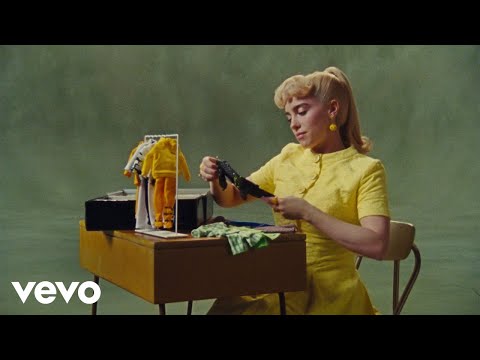
Billie Eilish
What Was I Made For?
Read
Narration sentence highlighting is idle.
A small piano figure begins with enough regularity to make time visible, but almost no push. The notes have a plain struck edge and then a soft fall, leaving space around each one. I hear the pulse before I feel it; it is a count under glass, steady and usable, but too delicate to turn into motion. When the voice enters near 0:11, it stays close to the keys, almost inside their decay. The first image, "I used to float," arrives already lowered by the line that follows it. The music does not dramatize the fall. It lets the drop happen inside a narrow range, one phrase at a time.
By the first question, "What was I made for?", the arrangement has taught me to listen for tiny changes in weight. A chord leans a little longer. The voice opens a vowel and then pulls back from it. The silence after phrases feels active because there is so little else to hide behind. In the Barbie frame, the words carry the shape of a made thing waking into uncertainty, but the track keeps that thought small enough to fit in a breath. It sounds less like revelation than a person trying to ask without disturbing the room.
The second verse around 0:38 keeps the same fragile machinery running, yet the surface starts to bend. The lyric turns toward appearance: ideal, alive-looking, unreal, bought. The piano remains spare, but the vocal presence becomes more exposed because the words have nowhere ornamental to go. When the line reaches "not real," the quiet feels cleaner and colder. There is no percussion stepping in to help the body. The song holds attention by refusing to thicken too soon.
At 1:07, the refrain changes the kind of stillness. "I don't know how to feel" is sung with such soft control that the uncertainty becomes a repeated physical action: inhale, lift, hover, release. The wish to try gives the first real forward lean, though it is still almost weightless. Around 1:20 and 1:25, the melody rises and then lets itself down, as if hope has to be tested in miniature before it can be believed. The humming that follows loosens language without opening the room very far. Voice becomes tone, and the piano keeps time.
The middle space after 1:30 is one of the track’s quietest strengths. Nothing breaks, but the song lets the words drain away for a moment, and attention stays caught on the repeating harmonic shape. The pulse is steady enough that I can predict the next step, yet the body never gets a full seat. I keep waiting for a larger arrangement to arrive, and the waiting becomes part of the form. The music is built from return, not expansion.
When the next verse enters around 1:49, the question has changed from identity to timing: when the enjoyment ended, how sadness returned, what cannot be handed to someone else. The vocal line stays almost conversational, but the closeness now feels heavier because the song has not moved away from its first room. At 2:07, the title-question returns with more history behind it. The piano figure is still simple; the listener has changed. Each repetition now carries the memory of the earlier one.
The refrain at 2:21 does not need to grow large to feel different. The voice repeats its inability to know how to feel, but the second pass has a finer ache in it, a little more reach in the held notes. Around 2:34 the phrase lifts, then eases back at 2:40, and the track’s restraint starts to feel like discipline rather than fragility. It is keeping the emotional temperature low enough that the smallest upward motion can register. A pop song this famous can feel huge in memory, but inside the recording it keeps making itself small.
At 3:00, the final turn brings happiness into view as something named from a distance. The melody moves with more consequence now, not louder in any crude way, but more certain about where the phrase must land. The words move from absence toward possibility, then toward waiting. When the voice reaches "made for" near 3:15 and returns to it again around 3:24, the song finally lets the question bend into a partial answer. The piano does not celebrate it. It supports the line and lets the release happen through thinning.
After 3:24, the track begins to empty. The pressure that had been gathered through repetition loosens phrase by phrase, and by about 3:39 there is a small gap where the music seems to step off its own edge. A faint return around 3:42 feels like continuation rather than a new section, a last small rise before the recording gives up its hold. Then the silence at 3:47 is terminal. Attention falls away because the song has stopped carrying it.
The whole experience is built from a steady pattern that never becomes comfort. Piano, close voice, and repeated question keep the listener suspended in a room where every slight lift has consequence. The Barbie context gives the made-object language its frame, but the recording removes spectacle until identity sounds like a private experiment in feeling. By the end, the answer is not loud enough to solve the question; it is only audible enough to keep.
Last updated Jul 24, 2026
Now playing
What Was I Made For?
Billie Eilish

galdr analysis
Click play to load galdr data.