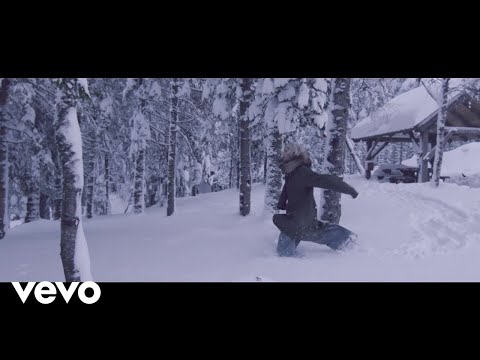
Aurora
Runaway
The song opens with a thin shimmer and a voice close enough to make the first image feel handheld. Aurora is not describing the ocean as scenery. She hears it as memory, then sees a face in the sand and watches it vanish. The arrangement keeps that disappearance in the air: light pulse below, pale vocal above, and enough space around both for absence to register.
By 0:33, the childhood image has climbed into the frame. The melody rises toward heaven and then falls back on the repeated descent. That small up-and-down motion teaches the whole song. Every reach has a return built into it. The rhythm keeps moving, but the upper texture stays fragile, as if running can happen without ever becoming escape.
At 0:50, the first chorus widens. The title action arrives as distance, speed, and question at once. The song imagines running to the edge of the world, but the beat keeps drawing a road underneath her. When the repeated not-knowing arrives after that, it does not solve the question. It turns uncertainty into a wall of mist that the voice keeps moving through.
By 1:03, the home plea changes the song's center of gravity. "Take me home" is the hinge because it reveals that the running was always pointed at return. The arrangement does not explode around the admission. It keeps the confession inside measured motion, which makes the need feel more trapped. Home is not reached here. It is named as the place the whole mechanism has been trying to find.
At 1:15, the second verse returns to image-making, but the chorus has changed how I hear it. A painted figure appears, almost becomes presence, then fails to hold. The track understands false arrival: bright surfaces flicker, the harmonic field stays warm, and the pulse continues as if the body can keep going even when the image disappears.
By 1:32, the lyric turns inward. Sorrow has been placed far away like something stored on a shelf, and the music has been doing a version of that all along: keeping grief at a distance through clean motion and clear tone. When the chorus returns at 1:48, the same running images carry more cost. The body now knows that movement and avoidance are entangled.
At 2:30, the song enters its soft-place-to-fall sequence. The repetition does not behave like filler. It narrows the whole search into one physical wish: somewhere to land without breaking. The arrangement presses forward but does not harden. The voice keeps lifting, and the track stays faithful to its spell instead of forcing a dramatic rupture.
By 3:04, the final chorus gathers the earlier distances into a direct demand. Running, rain, aliveness, and home return in a tighter chain, and the repeated home phrases sound less like destination than insistence. The pulse is still there, but the song is beginning to empty around it.
The ending releases by thinning out rather than resolving. The pressure drains, the vocal hold loosens, and the final plea hangs in the space the track has been opening from the start. "Runaway" works because its motion is suspended between leaving and returning. The voice looks outward, but the music keeps pointing back toward home.

galdr analysis
Click play to load galdr data.
Now playing
Runaway
Aurora
Click play to load galdr data.
Music signal
Surface evidence
Harmony + melody
galdr concepts
Derived motion